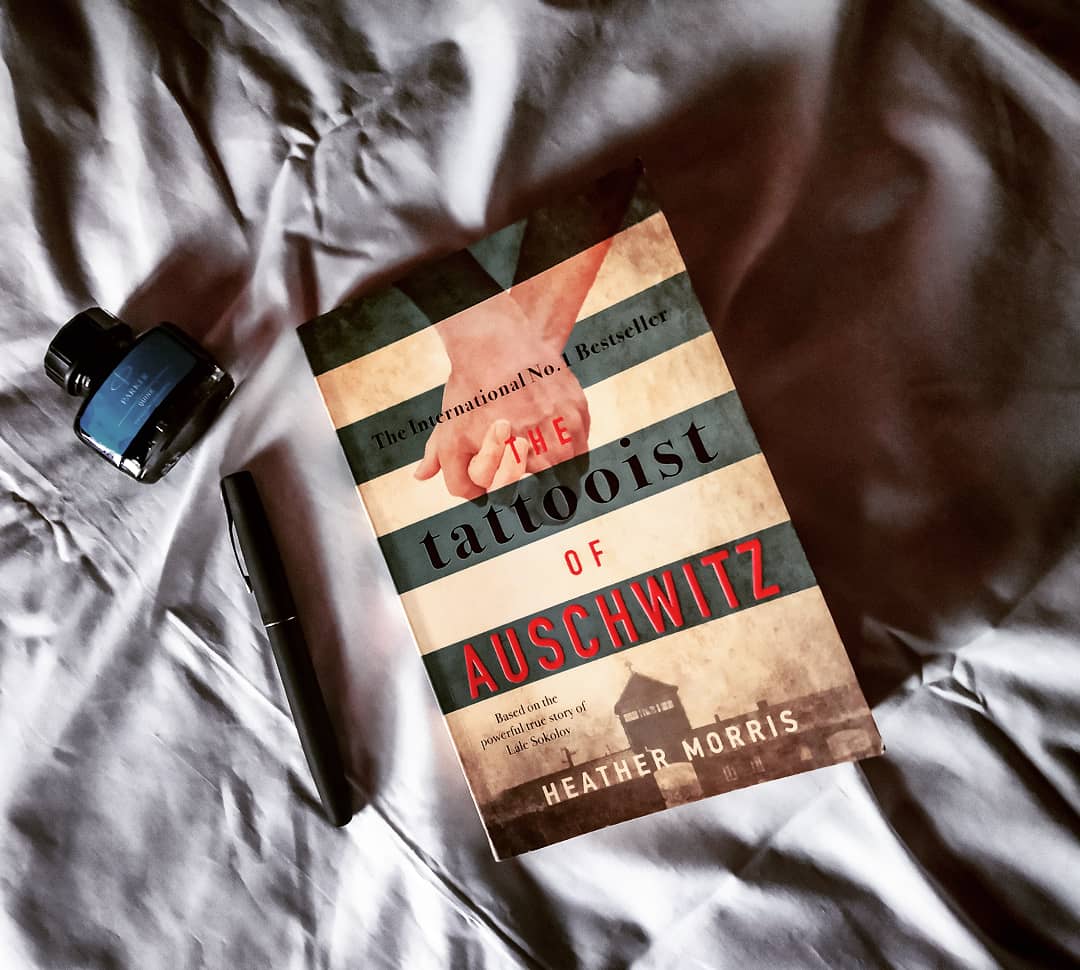
Based on the true story of Lale Sokolov, the book is an account of the Holocaust. Compelling narrative with successive gripping events are strewn across the book. Amidst the ash, mud, shouts, guns and looming death, blooms the flower of love. The concentration camps were truly nightmares and Lale’s first hand account recounts the horrors of the time and his survival through sheer grit and instinct.
For me the emphasis was on how the life of an ordinary man changed with the war. Not to mention the millions dead, the survivors weren’t the same people when it ended. I read the book in anticipation of dead, that only goes to say what it actually was for the people living there. The human cruelty upon its own race and the lack of acknowledgement is shocking.
Lale’s journey through the years made him see and do things that were driven by his survival instincts and he witnessed incidents that are merely dates and words for us. The situation is best realized with the pictures of Lale and his family and the proof of his being in Auschwitz. It finally hits home then. Indeed, there are numerous books on the Holocaust in the English language alone and readers have discredited this book for its too smooth ride, but the last few pages stands prove that reality often surpasses fiction.
Its Lale’s job alone that makes the subject of the plot more depressing, if that is even possible. Tasked with tattooing the bodies of the prisoners brought to the camps, Lale finds it difficult to taint the bodies of his fellows for ever. But to survive and to acquire a little more ration, he obliges. Lale’s kindness to other prisoners show that this is the characteristic that is still upholding the society: that a Jew, himself in mortal danger, would give his extra ration to the old and the children.
The writing of Heather Morris was heavily depended on dialogues and it often lacked to create the atmosphere for the setting or even the incidents. The effect, however intentional or unintentional, is that, you read on in an almost casual manner, with the events settling in as slow as a feather falling. The characters are not developed with detailed narrative preceding them but it is left to the readers’ discretion to build them up as their action portrayed them to be.
It is only Gita’s character that did not indicated much about her. If Morris was going for a mysterious air for the female lead, she successfully retained it till the end. Nothing of the personality of one of the two major characters was revealed. Was love this easy under such circumstances? I am not equipped to answer. It felt kind of pointless to have her not tell her family name and then disclosing it in such a dramatic manner. Doubtless, that is how he found his way back to her, but what was the point of concealing it in the first place?
The two major characters portrayed the two different attitudes when subjected to similar situations. Lale’s optimism was infectious and it almost succeeded to touch Gita’s heart, but her characteristic pessimism about not surviving the camp was apparent in all the conversations they had. Lale’s clever ways of smuggling food and valuables in and out of camp showed the gaps in the control of the Germans, while the German Kapo being bribed by him, a Jew, showed the innate nature of human kind and presence of basic corruption even in the torture hell of the world.
I cannot judge if I am moved due to the story of Lale or the subject matter that the book dealt with, but being objective, it is the slow dawning of realization that made me decide to recommend the book. Yes, definitely, there are better books with better plot lines and well developed characters and that are generally well written, but this one is a gem in itself. I rate it 3.5 out of five.
 The Calcuttan Bibliophile
Leave a comment