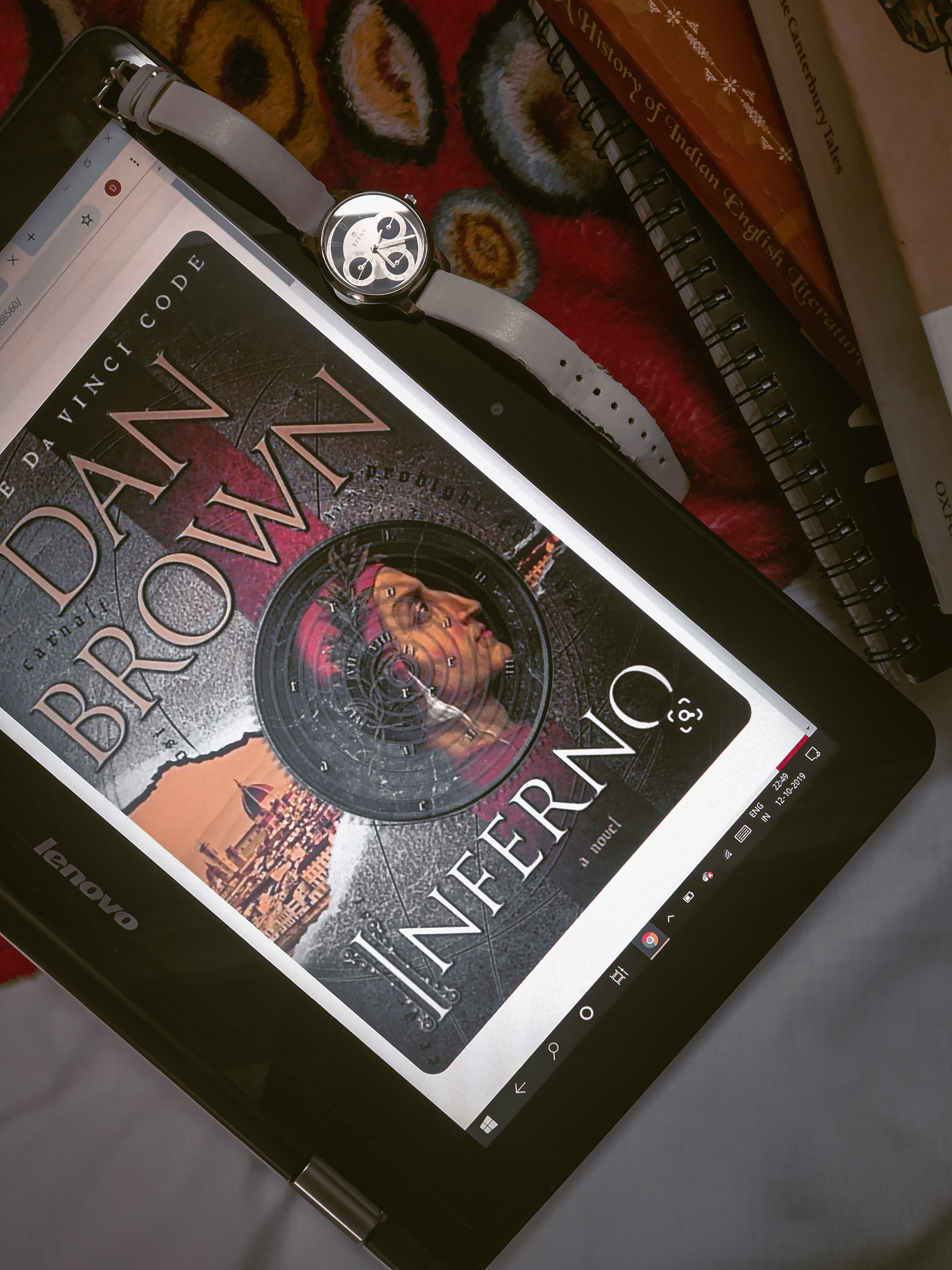
My second Dan Brown has much surpassed all expectations as it weaved a futuristic net of events in the shadows of the oldest cities of the modern world. The flux of history, philosophy, architecture and literature in this book has left me yearning for more.
The heavy allusions to Dante’s Divine Comedy are informative and interesting. While there are a number of theories explored and Divine Comedy discussed in details, the plot does not waver even for an instance. The gripping thrill keeps the reader hooked till the last page. The plot of deception being elaborate and there being a lot of travel included, Dan Brown does not lose the reader in the maze of the mystery.
Dealing with the practical problem of overpopulation on the Earth, Dan Brown weaves his mystery around two geniuses, Bertrand Zobrist and Sienna Brooks. While the Professor of History of Art and symbology, Robert Langdon, gets dragged into the spiraling plot, he wakes up with amnesia in Florence, and follows the clues to first Venice and then Istanbul. The breathtaking beauties of the cities are depicted with apt ability and smooth language. As the professor progresses by educating the readers about symbols, architecture and cultural history, the ancient world of Europe just before the Renaissance comes alive in the pages of Inferno. The three cities could be signifying the holy trinity, whereas nine cities to exactly portray the nine circles of Hell would definitely have been a little too much. The restlessness and fog of mystery is not unveiled till the absolute end, so the book proves to be a fast enough read [took me three days].
It is of 104 chapters and covers the usual international hazard, conspiracy theory, and Professor at the rescue plot. The book is of particular interest to me due to its commitment to deal with the historical significance of not just one book or one church but a vast expense of art and architecture, though limiting itself to one book. The practical problem and trans-humanism ideals present a disturbing image and reality to the readers. The ending was quite low-key compared to the chase around the continent but fitting nonetheless. But readers can find the race around the countries while escaping mercenaries only to end up pursuing an inevitably failed mission, futile. Probably, the reason why Telegraph has marked the book 2 stars out of 5. But the journey was more worthwhile for my reading experience to evaluate the book for only its ending. So I’ll give it a 3.5 out of 5.
The books itself is replete with symbols, the most prominent is the ending of it with the word “stars” as did Dante’s Divine Comedy.
 The Calcuttan Bibliophile
Leave a comment