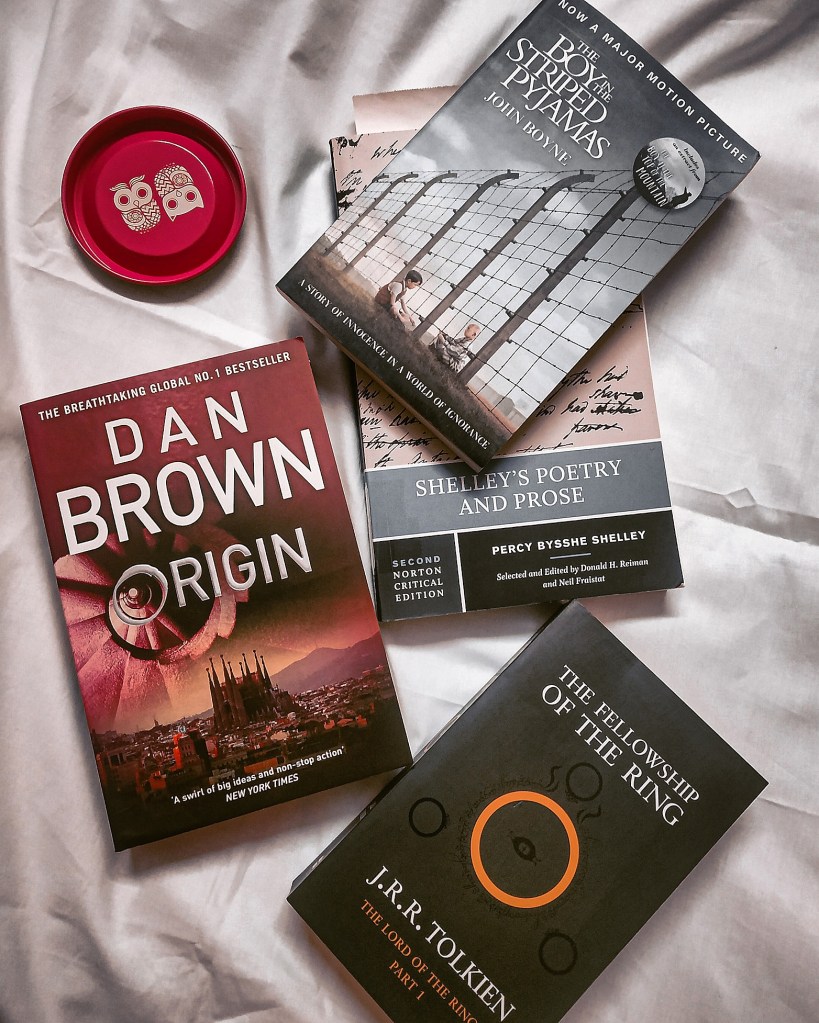
The fifth and latest book of the Robert Langdon series, Origin, has been getting mixed reviews and that is one of the primary reasons why I had been apprehensive in picking it up. But when I finally did, the problems with the plot were apparent.
Like any other Dan Brown book, Origin, is also about mystery and intrigue, through which the Harvard professor of symbology and history of art, works through. The incidents usually take him all around Europe and the mysteries unfurl gradually as you sometimes feel like the professor is actually taking a class on the topic of the book. While this experience can be a little daunting for people who are not that into the European art, history or symbology, it is an enriching experience where Brown incorporates as much knowledge about cities and art works as possible while keeping the plot of the books in sight. In this respect, the new book has been a little too descriptive and contemplative where it dealt with complicated scientific details. Though it is evident that the author explained his topic in layman’s terms, the concepts can be a little difficult to understand as they exist.
The story is set in Spain, and the plot takes the professor first to Bilbao and then to Barcelona. Bilbao’s Guggenheim Museum is the central focus as it is here where the main action takes place and it takes up a lot of space in the book with detailed descriptions of the artworks and the building of the museum itself. The plot follows around Langdon and his beautiful companion, Ambra Vidal, Director of Guggenheim Museum Bilbao and the future consort of the Crown Prince of Spain. The character of Ambra Vidal is definitely an upgrade from how Brown writes his female protagonists, she is an independent, successful and headstrong woman who doesn’t need to follow around Robert and has her own resources, and she pursues the cause with honest intentions unlike that of Inferno.
The descriptions and historical significance of cities and specific architectural spaces take up the majority of the book, which I most definitely found engaging while it was easy to see why it can turn into a slow read. From William Blake, Antoni Gaudi to modern abstract artists, this books discusses a long period of history and shows the distinct features as well as the distinctions between them. By incorporating theories and lectures of real physicists working on the matter of origin, like, Jeremy England, Brown gives his novel an aura of realism which almost overshadowed its fictitious quality. The scientific explanations and discoveries that Brown pulls our attention to are actually ingenious. I have to mention here that the inspiration of this book came to him from a musical composition of his own brother, Missa Charles Darwin, where he takes the structural composition of a Mass and uses excerpts from Darwin’s works as lyrics. It is absolutely brilliant how he has connected music, arts and science together to try and answer the question that he introduces through the character of Edmond Kirsch, billionaire, genius computer scientist. The point of deliberation in this book is the simple two moot questions of Where we come from and where we are going. By referring to real scientists and their works, Brown again paints a world that could go very, very wrong if the people are not responsible. The shift from history to the futuristic, scientific questions is stark in comparison to his usual style. The tone of his writing is changing and while I would not say that it has affected the plot negatively, it definitely has taxed it of its action packed movement. This book lacks the mobility and thrill of discovery in every few pages, that his other works had embodied. This is partly because the mission here has been fairly simplistic as to what Langdon had to accomplish in his other adventures, he came across various other intrigues while pursuing the main plot. This, somewhat, takes away from the thrill and makes the book more information oriented. Robert’s role in the action had also felt somewhat diminishing as his inputs have not been of exclusive importance, if had often felt that Vidal alone could have competently solved this mystery on her own.
The characteristic charm of the writing style will keep the reader guessing until the very end. The last hundred pages or so pick up the pace of the novel as begins to rattle the foundations of the country and gradually comes to an end. Just when you think that the mysteries are more or less solved, the actual climax takes place and makes you re-evaluate all that you read in the last three hundred pages. The subtle touch of supporting but very important characters being homosexual, portrays that Brown can do a better job at being inclusive in the future works. Regardless the apparent imbalance in content and action, Origin is a moderately thick book and requires concentration to get through. The vagueness of the different perspectives add to the intrigue and make the chase more interesting while bringing our attention to various contemporary topics. Dan Brown deals with religion and science here, and not only Christianity, like in Angels and Demons, but he actually challenges the teaching of all major religions of the world by attempting to redefine the Origin question. I think, this naturally requires details to establish, as well as the theories of the scientists through the ages require careful explanation to get the point across. While an interesting read, these qualities make the book a little difficult to be appealing to all.
I had no objections to the lengthy explanations or the difficult task of connecting these two theories in order to attempt a task that was virtually impossible to convey to the readers. But it is the ending with which I have a bone to pick. At the risk of giving away the prime spoiler of the book (stop reading here if you have not yet read the book), I have to say that the ending was something I absolutely did not see coming. For once, I thought that the futuristic novel was going to be different than all the rest. But even Dan Brown succumbed to the lure and made the incredible invention turn out to be something monstrous. It is a genie that took the commands too literally, and being what it is, it could not apply the human conscience to abort the mission. The plot turning in around on itself and painting the whole course of action as something to reconsider is a brilliant move but I had expected some originality from Dan Brown and the AI did it, is hardly something new, nonetheless, his style of uncovering that fact had rendered me astonished.
I do recommend Origin since there are only a few writers who would be able to deal with subjects such as these and still not complicate it beyond a layman’s understand and also because, it expands the horizon of a reader’s understanding extensively, it certainly did for me. 3.5 stars for this valiant attempt and almost complete success.
 The Calcuttan Bibliophile
Leave a comment