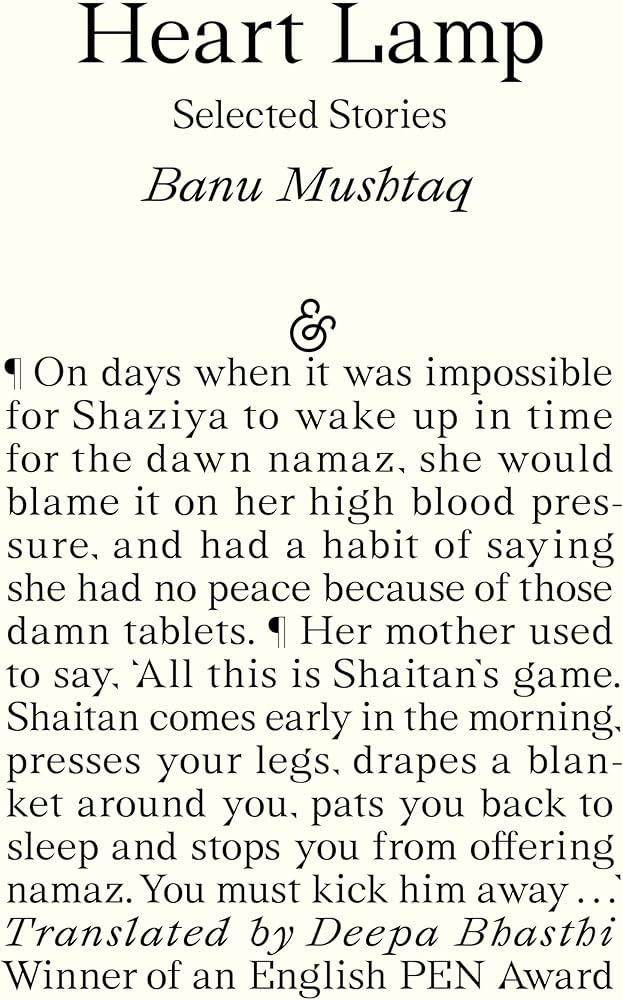
The short story collection Heart Lamp by Banu Mushtaq took the world by storm as it won the 2025 International Booker Prize, not only as the first short story collection to win the honour but as the first Kannada literature in translation to win the title.
Incidentally, I was flying through the stories just the night before and had woken up early to read the remaining stories I had fallen asleep to. So when I went to update my reading as completed, I was pleasantly surprised to see the news about the win.
What caught my attention was the lukewarm, if at all, literary appreciation in the reviews. Translated into English and published by Penguin Random House, the audience for the short story collection has vastly evolved from the original Kannada version. The stories, instead of bridging the gap as intentended, were being read by the West and dismissed as repetitive even though these were avid readers with the understanding of the formulation of a short story collection and its overarching theme. The book was even touted as the least likely one to be winning the Booker.
Reduced to a book about “wives and mother-in-laws” (First of all, it’s mothers-in-law), most of the reviews didn’t even touch upon the plot, overarching theme or even the literary masterpiece that this book is. So I had to pick up my keyboard (literally) and start writing the second review blog of the year. Thank you for tuning in and let’s dive in.
I will be honest, this was my introduction to Kannada literature. So when the translator, Deepa Bhasthi, says that there’s even a hierarchy in the written language which is again informed by geo-political spaces, I am surprised, but not really. As a Bengali from West Bengal, I am familiar with the politics of dialect superiority and its repercussions. I am forever fascinated by literature in translation and the Translator’s Note, in its clear justification of stylistic choices and addressing inequalities in the languages of India, opened up a new world for me.
But what about the stories?
The stories span 30 years of writing and it is not a stretch of imagination to visualise the world Mushtaq depicts in her stories. I took offence at the “wives and mother-in-laws” because that’s exactly what the writer shows women to not be while the society relegates only these titles to them. She shows these women as individuals beyond the social and very gendered role they play in a patriarchal society. Her portrayal of women spans class and age as it strives to show how women are just expected to give up on their studies because there are young children at home and the mother needs help rearing them. Then there’s child marriage being talked about while referring to the previous generation. Cheating, alcoholism, domestic violence and shirking financial responsibilities for men is the norm on top of all this.
Scriptures are cherry-picked to justify the will of the man while women are suppressed and kept oppressed.
Trying to summarize the plots of short stories is pointless and would take away from the reading experience so deliberately avoiding those, I would highlight the mention of one upper-class woman with her nose deep in tomes, advising the house help about her rights as her husband marries another woman for money, for sons. This woman has all the logic but none of the lived experience of the plight that the other section of the society is going through. A reader cannot help but identify oneself in her because you are thinking the logical arguments she is presenting, you are wondering why don’t they seek legal help, you’re wondering why doesn’t she go to an elder of the community. And then that story’s ending answers all the “why-s”, it is a man’s world and the men have conspired together to keep the women under their foot.
These women don’t know about the theories or how all of this is playing out in a global scale in the contemporary world. All they care about is often their survival and sometimes their honour, in these stories. They are not saints. They are often conditioned by their mothers, elder sisters and mothers-in-law to be complicit, both in their own oppression and becoming the tool to somebody else’s. There is recognition, acceptance and when it’s too close to home, the urgency to rectify the situation at whatever cost. But then there’s the helplessness of the truly powerless who have been dealt the wrong card across the board. Class and social influence brought into these narratives play a bigger role in the juxtaposition of the microcosm onto the macrocosm.
For stories like these, usually the shock factor is the USP. What I loved about this short story collection is that in its brevity and an oral storytelling format, it is also very casual in its narrative.
The casualness of the narrative belies how the casual cruelties are inflicted on the women in the name of tradition and religion.
More than a critique of Islamic law and its enforcement, this book shines in its celebration of resistance, of women asking questions — demanding answers, sometimes from other women, sometimes from the society and sometimes even from God. From witch burnings to Sati, this book is reminiscent of social injustices against women in the name of gods.
In keeping with the larger theme of the stories, the oral storytelling style stands out. Women have inherited the gender violence as it still continues across the world to wield power over a whole section of the population. That inheritance comes with the stories told in kitchens, away from male ears and comprehension and the narrative style keeps the stories alive with the spoken-over-fire element.
It was, intially, wonder and, later, rage that kept me turning the pages (well, scrolling the pages) and it was a vital representation and genius that won this book the recognition it deserved.
 The Calcuttan Bibliophile
Leave a comment