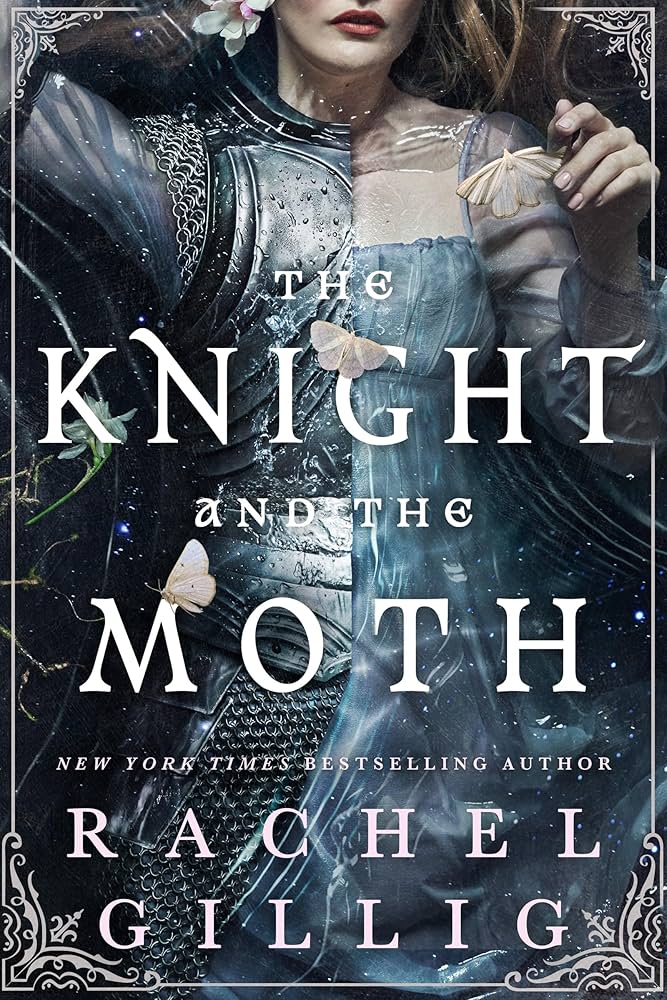
Rachel Gillig’s new release of 2025 has been on every fantasy fiction reader’s most anticipated book releases of the year. I had not been an exception, well and truly on the bandwagon. The Knight and the Moth is Gillig’s 3rd book following the Shepherd King duology and promised a dark, gothic atmosphere with characteristic strange world-building and a magic system that has a touch of whimsy to it.
I would be honest, the book was a little difficult to get into. Its intense strangeness was so potent that nothing made sense initially and I was left puzzling out the why-s and how-s. But about 70 pages into it, I was hooked. But is that really good writing? I am all for a slow-paced fantasy that does the world-building in detail and gets into the nitty-gritty of the magic system, so I was pretty put off by this book that kinda touched upon everything but didn’t delve deep into anything.
You get a sinister feeling of wrongness from the get-go as the setting of Aisling Cathedral looms large in all its greyness. The six nameless Diviners are supposed to be confined to the cathedral and sentenced to drown in the magical spring water for 10 years to divine the signs of the six god-like Omens. These women have been stripped of their previous identities, they don’t remember who they were before Aisling, and have their eyes covered. Even though they break the other rules of their “home” freely, they haven’t tried to take off their shrouds, weird.
Then arrives the mysterious boy-king, Benedict Castor III, and his entourage of knights. They are flouting the strange rules of the place and the Diviners are fascinated. Our protagonist, Six (yes, denoted by a number), is the picture of obedience, but the events following the arrival of the king and the knights plunge her gloomy world into further confusion.
Six’s sister-diviners start to go missing one by one.
With their 10 years coming to an end soon, Six is confused and scared, to say the least. But this obedient and meek Diviner is also someone who has a self-assuredness about her. So when the Abbess doesn’t give her straight answers about how the sisters are disappearing, she embarks on a quest to find them herself.
But she is someone who doesn’t remember anything of the world beyond Aisling. Enter the king and his knights. The king’s close circle consists of Maude, now that’s who I call badass, and Rory, an aloof, broody knight with a tragic past who looks good in and out of his armour (checks list to qualify as a romantic interest in contemporary fantasy). Six makes a deal to help them on their ongoing quest in exchange for their help with finding her sisters.
The quests are repetitive, the main characters are not well-developed, but the side characters steal the show and the twists in the plot were pretty predictable. With a slow pace, lots of atmospheric world-building and a gothic mystery that was not much of a mystery, I would not have finished reading this book if not for the name on the cover. I liked the spooky, dreamlike quality of the atmosphere Gillig built with her exquisite language and I loved little Bartholomew (let’s be honest, we all did). I kept turning the pages to know the fate of Bartholomew, at once the comic relief and the element of mystery, and I wasn’t disappointed.
I know I went in with a lot of expectations and it was bound to not meet the hype in my mind, but I didn’t quite expect to not care about what happens to the characters going forward.
Six embodies that feminine righteous rage and her quest for reclaiming her identity beyond being “Six” or a “Diviner” was almost moving, but it was such a given from the beginning of the book that I didn’t quite care. The romance with Rory felt very forced to me, the kind of enemies-to-lovers felt unnecessary and didn’t quite flesh out their attraction to each other — they were just two attractive individuals, with enough air of mystery, in proximity to each other. There is potential in the magical ecosystem introduced in this first book. But book one of the Stonewater Kingdom duology didn’t do enough to build that world, even though it was a slow-paced read.
Is it a recommended read?
For the atmosphere, yes.
For the plot or characters, no.
For Bartholomew, YES.
 The Calcuttan Bibliophile
Leave a comment