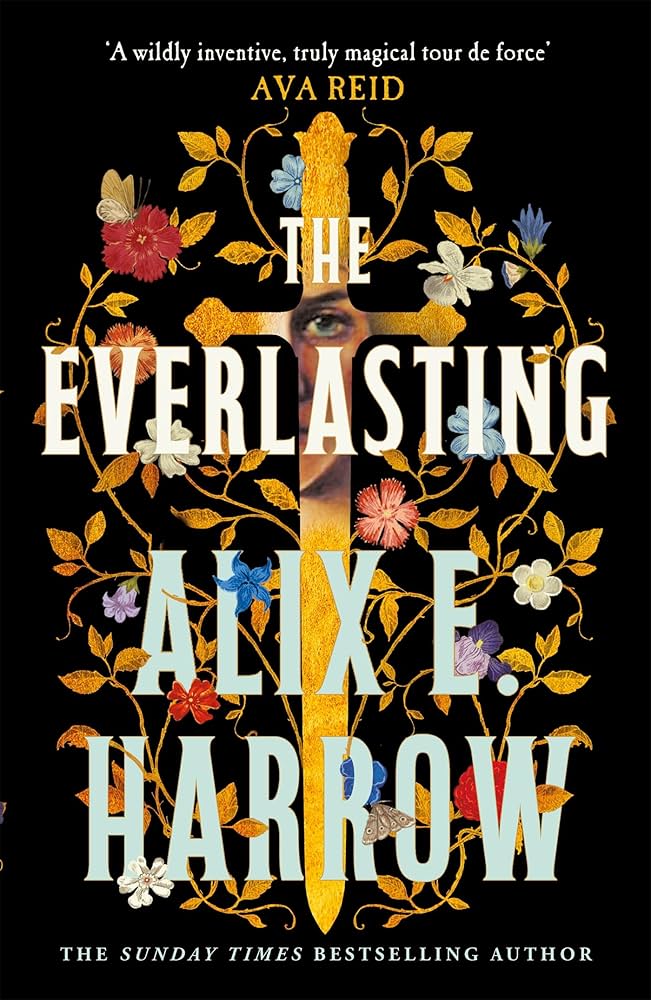
After reading Starling House earlier this year, I knew I had to get my hands on The Everlasting as soon as Alix E. Harrow confirmed the book release dates. I finally got to read the book and the epic proportions of it took me out completely.
What if history was not an accident but a story told many times, in many different ways to serve a tyrant the best?
This is a story of a self-proclaimed coward and his bravery and honour. This is a story of a girl made a soldier, knight, legend, myth and her desire for an unremarkable life. Sir Una Everlasting had died for her queen and country. Almost a thousand years later, the citizens of Dominion are still sent to war in her name. When Owen, a cowardly soldier and ambitious historian, slips the reins of time and meets the legend herself, he remembers her. They have done this before. They do not know how many times.
Some books are written so well that I am loathed to even summarise them. I feel like I am already giving away too much. This was one such book in its narrative style and plot. There is heavy-handed criticism of war, questioning the idea of a nation, and basing a country’s ideology on a nation-building myth. I found all of it very relevant and extremely well-presented. There is the politics of identity as a mixed race person in a country at war with its neighbour that adds a different aspect to the actions of the characters. Very typical of Alix E. Harrow, there is also eco-criticism as the war efforts and the growth of civilisation encroaches upon the natural world and calls for the death and destruction of all that has existed for a millenia.
The epic scale of the narrative timeline stayed on course despite looping through various eras and acts of the same story. It was neither confusing nor boring and I do not even like time-loops. The Everlasting had its hooks in me from the very beginning. If you have already read the novella Six Deaths of the Saint by Harrow, which I had, you already know that this book is an expansion of that story. The author has made changes to it to make it even more poignant and hammer in her critique of consolidation of power and the cost of retaining it.
Harrow’s dry humour added a whole other layer of tragedy to the story. I experience a sense of similarity in Alix E. Harrow and T. Kingfisher’s writing. I don’t know if this is because I have come to love both of their works across genres or if there is actual similarities between them but I think the style of unironic humour in serious situations is definitely a common trait that I enjoy in both their works.
As the characters get stuck repeating the story with a predetermined end, they debate freedom. But each of them are doomed to repeat history because of who they are, their honour, bravery, and loyalty. Love chains them to the inevitable end and love breaks the links of the chain. But “…who is free who loves?”
Harrow’s Arthurian romance embodies the best of the knights in a single figure. Una Everlasting does not fit in a mould. Despite giving the reins of her life to someone else, she manages to surprise the reader through her knowledge, restrain, and actions at every turn. The author has crafted the tale and the characters with depth. Owen’s struggle to reconcile the myth with the woman is a familising plot device to get the readers to see Una as a regular person beyond the propaganda. This world of fairytale is given the details of history and then coloured blue with yearning.
I want to say that this is the blueprint for writing erasure of history, but that implies that this can be replicated in all its glory and I am less sure about that.
The image of performance is scattered throughout the plot — stage, spotlight, stagehands, direction — and it encapsulates the feeling of helplessness in the characters as they are sent back in time again and again to act out a tragedy just sad enough, just just enough, just patriotic enough to secure power for the people pulling the strings. At one point, you do not know truth from the lies as a reader.
There are representations of different sexualities that play into the plot and are not just embellishments. The non-gender-conforming appearances of the protagonists added a layer of perception to the story. Harrow places a lot of weight of the plot on relationships and these are not just romantic ones. I liked how she explored different kinds of familial relationships within the plot and gave them real meaning. Even the villains are written with substantial character arcs. All of these combined, gave the whole story an air of intentionality that made it a very satisfying read. She ties up all the loose ends without missing even a thread.
To say that I was moved by this book is an understatement. I am definitely looking forward to reading the rest of Alix E. Harrow’s backlist.
You can pick up a copy of The Everlasting here.
(If you use the link to purchase, I earn a small commission to continue reading and reviewing)
Have you read any books by Alix E. Harrow yet? What are your favourites?
Feel free to drop a comment or reach out to me across social media at @thecalcuttanbibliophile. I would love to hear from you.
 The Calcuttan Bibliophile
Leave a comment