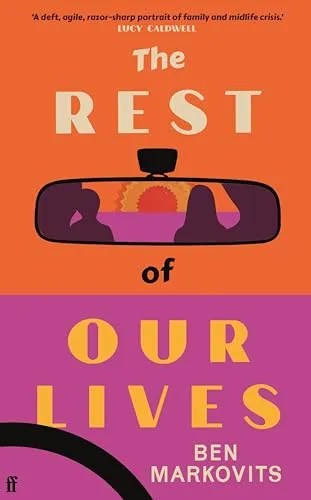
Reading all of the Booker Prize Shortlist 2025 truly became an adventure for me with “The Rest of Our Lives” by Benjamin Markovits. This is a pretty short literary fiction at about 170 pages and has a fast-paced narrative.
This is the third book on the list that I am reading and after “Flesh”, I, honestly, was not looking forward to reading another about lonely man’s perspective. In that sense, “The Rest of Our Lives” surprised me with its candidness and my ability to actually relate. I literally have an entry in my notes saying, “Coming to like this better 40 pages in.”
At the cusp of quarter life, I am uniquely positioned to comprehend that the rest of my life will reflect how I spend the next few years, while I can also realise the shadow of disappointment in my elders’ eyes about their unrealised hopes and dreams. This book hit the nail on the head on both those experiences through Tom and his daughter Miri, one embarking on a surprise roadtrip to deal with his mid-life crisis and the other tasting freedom away from home for the first time as an adult.
This is a story about a non-reactive man watching his relationships fall apart as his health declines. Tom is in his 50s. His youngest child, Miri, is now leaving for college. His marriage with Amy was hanging by the thread of the children still being home. Now, an empty nest could very well translate to a divorce following Amy’s infidelity 12 years ago. The threat of this divorce on Amy’s head has her anxious and worried on top of dealing with her children now being independent. The trajectory of their lives depends on Tom’s decision, so when he goes to drop off Miri at college, he does not return, effectively putting his life on pause. He drives around coast to coast — very American in essence — and reconnects with people from his past and attempts to write a novel on pickup basketball, an old project from college.
Despite all my complaining about male protagonists going through life with no accountability, specially in review of Flesh, I think I liked this story better because there were consequences to Tom’s actions regardless his belief about his own accountability. The story being told from Tom’s perspective, we do not really get an objective view about how he is as a person. Tom is constantly excusing his non-involvement in family matters, his colleagues’ and father’s racism, his own conservative views on life.
Tom is stuck in a marriage he has given up on. He is stuck in a job he never wanted. Now that he can be free of both, he realises he does not know who he is without these two defining factors of his life. His attempt at getting a client on his own lands him with someone trying to sue the NBA for discrimination against white athletes and he left sitting there in the meeting wondering what he is doing. So he just follows the road. He visits his brother, an ex-girlfriend, this client who is also a friend from college, his son, all the while ignoring his consistently worsening health.
The sort of meandering style of writing is still very fast-paced and captures the futility of a life lived for others well. The complexity of Tom and Amy’s marriage and how it keeps making a victim out of her despite her being the perpetrator is extremely interesting. At one point, Tom says he does not wish to write about other people and their lives and cannot write about his own, he only wishes to sit around and read books — and I have never felt more seen. But when he sees this attitude of not following through in Miri, he realises the fault in it.
In the process of running away from his issues, Tom falls head-first into the hospital. The non-linear narrative keeps circling back to the deteriorating health of Tom and his willful ignorance of it as his face swells up every morning and after the slightest exertion.
When he finally is taken to the hospital, it is his family that is there for him. Amy is his primary care-giver and his children are worried about him, checking in constantly. He is dependent on this family that he had been so determined to run away from. None of the people he meets on his road trip are even notified of his circumstances.
This is a strong commentary on perceived choices as well. Throughout the book, it is intimated that Tom holds all the cards in his marriage and work life. The reality is far from it. The power imbalance in both dynamics end up humbling Tom — whether he actually realises it or just goes with the flow without any accountability is a question for another day.
Among the Booker Prize Shortlist, I would say this was at the same level as Audition for me, maybe a little higher. Follow along for the next 3 books on the list and do not forget to share your thoughts on this one.
You can grab a copy of “The Rest of Our Lives” here.
(I earn a small commission from every qualified purchase from the link to continue reading and reviewing)
Have you read any of the Booker Prize Shortlist books of 2025 yet? Which ones are your favourites?
Feel free to drop a comment or reach out to me across social media at @thecalcuttanbibliophile. I would love to hear from you.
 The Calcuttan Bibliophile
Leave a comment