
When I saw Ling Ling Huang has a new book out in 2025, I knew I had to read it. “Immaculate Conception” became my last read of the year. I needed the day off from reading after that tech-dystopian plot.
The release of this book in May, exactly two years after “Natural Beauty“, solidifies Ling Ling Huang’s May release tradition. There are a lot of ways “Immaculate Conception” is similar to “Natural Beauty”, the genre being the primary aspect, but Huang’s second book dives deeper into human emotions and connections.
The biblical reference in the title had my interest piqued knowing the kind of work Huang writes. Then, I saw this book mentioned in a Dark Academia list and I was invested. I had liked R. F. Kuang’s “Yellowface“, “Babel“, and “Katabasis” (review here), and Dark Academia rivalry was right up my alley. Huang took those tropes and blew it out of the park; I am somehow not surprised. She dives into the psyche of jealousy in art school and complexities of the art the characters produce and a protagonist constantly grappling with the self-perception of her inferiority complex.
Enka is from the fringe of the society, literally. This world is divided along arbitrary lines based on a predictive algorithm that calculates the likelihood of potential crimes that could be committed by someone and assigns them enclave or fringe status based on the results. You are literally on the outside if you are fringe. Limited access to the internet, art, culture and facilities means Enka was the odd one when she fought her way to art school. Already dubious about her own capabilities, art school becomes a rude awakening for her and at the center of it is Mathilde. Insanely talented, gifted in any medium she picks and with a finger on the nerve of the art scene, Mathilde is the mysterious and tortured artist that is destined for greatness. The opposites create jealousy for Enka while fostering an attraction to the enigma that is Mathilde. As their unlikely friendship grows, so does Enka’s secret resentment for her. Constant comparisons in her head makes Enka intentionally sabotage the well-being of Mathilde. With everything she ever wanted within her grasp — social presence, doting husband, adorable children, and affluence enough to provide for her unsupportive parents — Enka still chooses to not let Mathilde go. She opts for invasive technology that violates Mathilde’s autonomy and ends up reducing her to a husk of a person. But to what end?
This could have been just a Dark Academia plot and that alone would have been enough, but Huang takes the story to a not-so-distant tech-dystopian future. As students, they face an algorithm generating art and essentially, making them useless. As they grow up, the tech is seen advancing rapidly in the biological scene. Tech-integrated biology becomes as common as a screen-infested lifestyle.
Huang, in her prophetic style, depicts this world where biotech has progressed in leaps and bounds without checks to the point where it has become harmful to humanity and any act of creation — be it art or life. Enka’s love, that is a prison, only gets amplified in its intensity by the aid of invasive technology. She ends up destroying both Mathilde and Logan, her own husband.
The layers of betrayal in this book are astounding. Huang has dealt with a number of issues in it and the plot has become multi-faceted, but it blends in seamlessly despite being heavy in social commentary. I only had one complaint; Enka is given a sort of absolution by the end of the book, and I did not feel like she had suffered enough or sacrificed enough for that to happen. Enka is painted as a product of her situation and the villain, then, becomes the societal structure, the people who are enabling some and cutting off others based on their whims. In the societal system, “Immaculate Conception” was reminiscent of “The Dream Hotel” by Laila Lalami, another top-read for me in 2025.
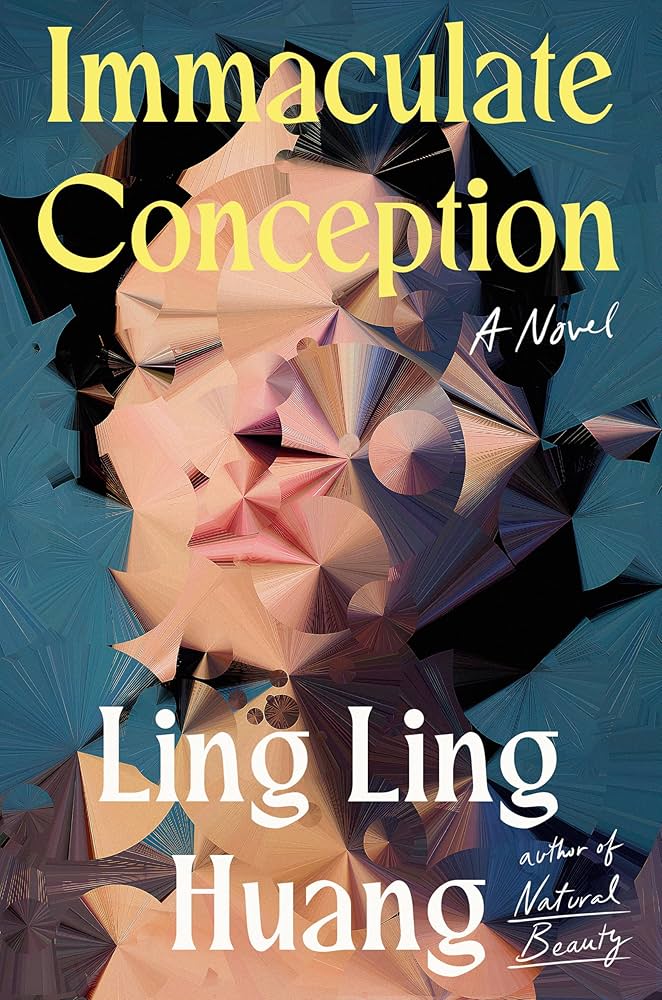
I really liked the cover that conveyed Enka’s warped mind through the art imposed on the woman’s face. The title also gains layers of meanings as the artists conceive of ideas and give birth to the artworks on their own and later on, Mathilde pulls off a true immaculate conception. At a stretch, even Enka’s own perception of the self that drives this plot is also an immaculate conception, needing no help from anybody else to construct only inferior opinions of herself. It is a shame because Enka really had people in her life who cared about her and saw her as the talented artist she had always been in reality. The story frames it in a way that Enka’s obsession with Mathilde drives her actions but I felt Enka’s obsession with her own perception of lack of excellence was the highlight.
This story will stay with me as I move on to the next reads of 2026, and I cannot wait to forget enough details of the plot to revisit this again. Definitely, recommended.
You can grab your copy of “Immaculate Conception” by Ling Ling Huang here.
(I earn a small commission from every qualified purchase from the link to continue reading and reviewing)
Have you read any of Ling Ling Huang’s works? Which one is your favourite?
Feel free to drop a comment or reach out to me across social media at @thecalcuttanbibliophile. I would love to hear from you.
 The Calcuttan Bibliophile
Leave a comment