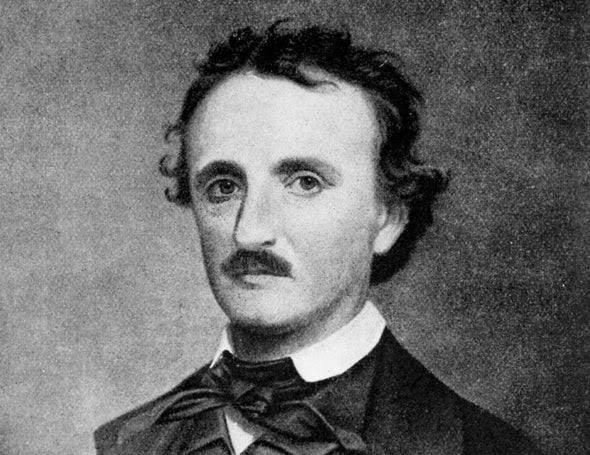
In a guest piece this time, I’m hosting a friend and fellow bibliophile Kohana Mukherjee on my blog as she shares her perceptions on the short stories of Poe.
–@thecalcuttanbibliophile
“In our endeavours to recall to memory something long forgotten, we often find ourselves upon the verge of remembrance, without being able, in the end, to remember.”
─ Ligeia“I seemed to be upon the verge of comprehension without power to comprehend – men, at times, find themselves upon the brink of remembrance without being able, in the end, to remember”
─ The Murders in the Rue MorguePoe’s short stories are puzzles that is pieced by narrative of memories – fragments collected and put together to complete a rational comprehensible picture. His narrators are central players in his stories who do the exploring or speak their minds (in “Tell Tale Heart” and “Ligeia”) or through Monsieur C. Auguste Dupin (“The Murders in the Rue Morgue” and “The Purloined Letter”). Poe’s narrators are engaged in a linear formulation of time, the telling of a story chronologically from Point A to Point B until it reaches a fine end with no lose ends. Regardless of who the narrator is, the narration itself is a puzzle with scattered or missing pieces that needs to be put together by both speaker and reader. However, there is nothing new to how one reads crime thriller fiction – Arthur Conan Doyle and Agatha Christie polished and problematized their crime narrators further in their novels. What is strikingly different and perhaps unique to Poe’s stories, in my opinion, is language – in writing and in dialogue; there is a stress in the linguistics used and the linguistical search which are intertwined into memory, inspection and piecing the narrative together:
The narrator in Tell-Tale Heart is a nervous “mad” person. The language he uses to convey his story is comprehensible but also of his own making. It is his story to tell, his murderous motive to justify to the readers. The frenzy juxtaposes with his wise calmness he boasts about so confidently throughout the story –
“what you mistake as madness is but the over-acuteness of the sense”
The narrator’s crime takes place both in the physical realm as well as in the realm of the mind; the readers never really can make out whether the loud thumping of the heart is the killer’s or the killed, or a chaotic beating of them both. In the end readers are left to figure that out by themselves.
Like most Dupin detective crime stories, “The Purloined Letter” and “The Murders in the Rue Morgue” are stories told in the language of the past reconnecting to a present point. The discourses of the criminal’s/suspect’s mind take up most of the pages of these short stories rendering them towards analytical stories of fiction that crime thrillers. Dupin comes as close as one can to bring together all perspectives and utterances together in a chronological manner for every story told. Granted, that is the detective’s job, but he isn’t a detective per say. He is an onlooker who is an excellent observer and keen in pursuing knowledge; anything that is mildly curious that presents as a challenge for him to solve. Therefore, his justifying grounds are purely based on words – language of speculation and remembrance. Agatha Christie’s Poirot was scrutinized under this same microscope. Proving a criminal’s crime can only be done with evidence and that is what Sherlock Holmes was bent on in his stories. Poe spent his time exploring and exposing the minds of the criminals theoretically in fiction – their motif or lack thereof, the intricacies of the killer’s murder, et cetra. In a way, I would say Dupin’s soliloquy-slash-discourses sole reason is to bring all memories of eyewitnesses’, reports, and his own analytics into one whole – he is the chess player figuring out the game by elimination and deduction and checkmating the criminal at the end. It is all but mental action – all of the logistics are being calculated in the dome of the mind, hence speculative. But perhaps, that is his role in Poe’s stories.
It is he who brought to light that language is one important aspect that needs to be thought about when investigating crime –
“Madmen are of some nation, and their language, however incoherent in its words, has always the coherence of syllabification”
In “The Murders in the Rue Morgue”, the suspect’s identity was obscured because no one could figure out what tongue he spoke consequently hindering the process of solving the murder mystery. Everyone who heard the screams/words in the Rue Morgue speculated a foreigner as suspect. But in the end, we find that the death was caused by an orang-outan whose owner is a French sailor man sailor cognizant of the murder. What does this really say? – that our senses are limited and that language is limited. Which what made me think that these narrative are subjective in their approach trying to form an objective whole – each utterance is unique to its story even if the end is to seek closure.
While the Parisian police “have no variation of principle in their investigations […] or exaggerate their old modes of practice, without touching their principles”, Dupin moralizes that “the great error lies in supposing that even the truths of what is called pure algebra, are abstract or general truths”. The ‘truth’ is not always so blatantly out in the open with a label on. Dupin is spot on in his analogy and perhaps that is why his job is to converge all narratives to a point of comprehension giving closure to insolvable circumstances.
He is the ‘translator’ who rationalizes and brings to light all that is veiled under the forgetfulness of memories –
“the material world abounds with very strict analogies to the immaterial; and thus, some colour of truth has been given to the rhetorical dogma, that metaphor, or simile, may be made to strengthen an argument, as well as to embellish description.”
The story of Ligeia is the most abstruse but perplexing in narrative. The story envelops the themes of gothic horror delving into supernatural territories. The speaker’s narrative is drugged in Ligeia’s beauty and opium-infused ‘coloured dreams.’ All that happens is shrouded in unsurety, doubt, “trammels of opium” and the excitement that ensues from such a state of mind. Here is a story of memory that keeps fading in and out in confusing glimpses and the narrator literally could never grasp at anything concrete; his language keeps slipping from him resulting in a tale that is weaved in imagination, waking, dreams, shadows, and clouded visions. It is a struggle to remember and to forget but never a conclusion does he reach in either.
“Man doth not yield him to the angels, nor unto death utterly, save only through the weakness of his feeble will.”
In both comprehension and in remembrance do we fail in grasping the complete truth/knowledge and these four stories illustrate exactly how the human mind is perceptive, subjective yet fragile as memory cannot be recalled fully or completely. We live our lives in broken moments and fragments that have no chronology or linear pattern and there is only so much that can be done when using language as a tool to materialize our experiences. Poe’s stories do not just explore criminology in a new light but also speaks of the liminalities language and mind treads on.
─ by Kohana Mukherjee
For similar content, you can connect to her on Instagram at @thekohanacritique
Her blog is at https://sagaquest.wordpress.com

 The Calcuttan Bibliophile
Leave a reply to pentealope Cancel reply