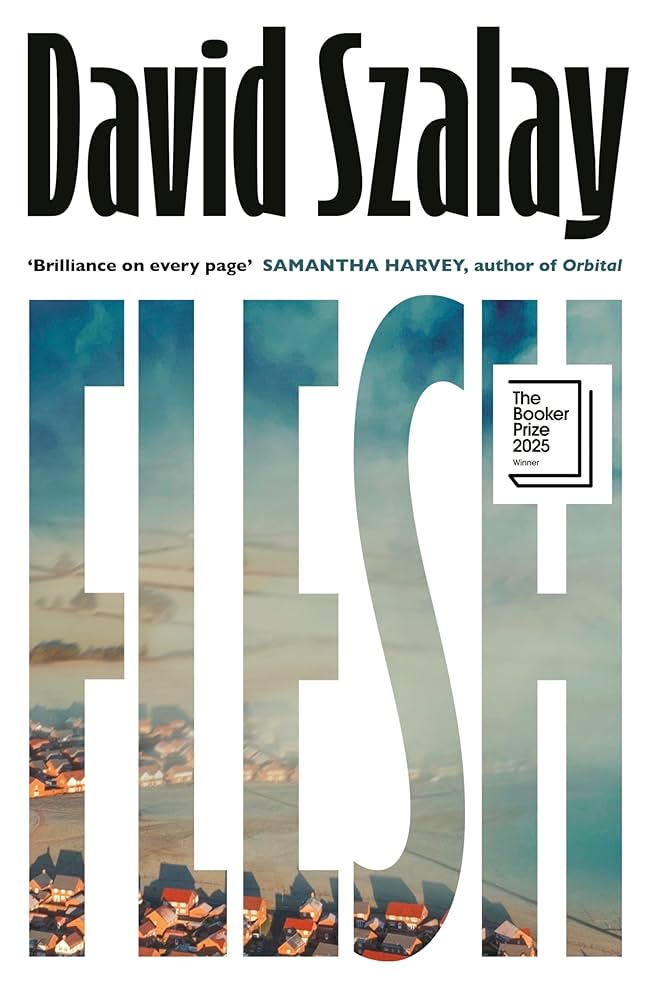
Flesh by David Szalay was a good book to read to stop reading literary fiction forever. This book was a confusing read for me in that I didn’t understand why this was on the Booker Prize shortlist and then the winner of 2025.
I will summarise most of the incidents in the plot for you, I’ll leave the end for you to read if you wish, and represent exactly how I felt reading each supposed arc of his character.
Like Audition (read review), this story is also told from the perspective of an unreliable narrator. He is named this time, Istvan. The story opens when he is a teen in a small town in Hungary. He is curious about sex and being turned down by a girl his age and shunned by his male friends because of it, he falls into a comfortable routine of grocery shopping with his older female neighbour after school. This, unfortunately, evolves into her molesting him. In true stoic fashion, Istvan cannot process this as something being done to him, so he attempts to take control of the situation and establishes a relationship with this neighbour.
He constantly thinks about how disgusted he is of her body in minute details. He has no friends so he cannot gloat about sleeping with an older woman publicly. His single mother’s and her older husband’s absence at their respective apartments fuels this affair until Istvan confesses his love to her. She shuts the whole thing down immediately and Istvan goes mad with yearning for her despite his previously professed disgust for her body.
One thing leads to another and in a confrontation with her husband at the top of the stairs, Istvan pushes him down the flight of stairs, breaking his neck.
Spoiler alert: he never goes to therapy for anything that happened during these years of his life. Neither does he introspect about any of it.
Istvan goes to jail. His years in the correction facility is glossed over. His experiences, his realisations, being locked up during his formative years — we do not get any of that. Next we see him back in his mother’s apartment, unemployed, running drugs with the people he had fallen in during his prison time. This part of his life is dogged by his desire for his step-cousin. He takes her up to the lake and tries to seduce her and when she says no, she is scared of him, unsure if he would actually listen.
Then there’s the job at the winery that his mother gets him but he punches through the door and breaks his hand, rendering himself unable to work. His mother is there at the hospital with him.
Then he is at the military, in Afghanistan, in Iran. When his service ends and he is in Budapest, almost back home, living it up with other soldiers who completed their service with him. There are misconducts, drugs, orgies involved. There are no consequences to his actions anymore.
There is a brief stint at therapy, for PTSD because that could be the only reason a “man” could be in therapy. He talks about his fellow soldier dying in his arms in an attack in Afghanistan. This is pretty traumatic but the character disassociates to the point that, as a reader, I didn’t feel any empathy for him.
Events leading up to this point were disorienting. I couldn’t tell you if the winery incident happened before he worked as a drug mule or if he went to the lake with his step-cousin while he was working at the winery. In the grand scheme of the plot, it does not even matter.
Next we see him in London. This is the comparatively good part of his life. He saves an elderly man from getting mugged while he is working as a bouncer for a strip club and the man gets him security gigs for rich people at his company. This man grooms him for the jobs, buys him food and clothes and teaches him how to behave. Istvan finds a good client and joins his household permanently as a driver and security. He is also sleeping with this new boss’ wife. So when his boss’ cancer comes back, he is in treatment and Istvan is keeping Helen company in Berlin.
Following the boss’ death, Istvan marries Helen but his relationship with the boss’ son and heir is not so smooth. All this while he has his son with Helen on the way.
In old age, the consequences of his actions catch up with him.
I will leave the rest of the details for you to read.
More than Istvan’s story, this book felt like his unnamed mother’s story since it ends with her death. Her failure as a mother as her delinquent son keeps making bad choices and pretending that bad things are just happening to him for no fault of his own felt like more of an apt story. Istvan is a depraved human being who lives off of the women in his life while he is secretly disgusted by all of them. He is every red flag in the book and then some.
At one point, Helen’s female friends are staying over at the house and when they leave, Istvan describes a sort of sadness because as long as the women were in the house, he was feeling like he had a harem present. I am surprised that this is the kind of male perspective and lifestyle that The Guardian celebrated for centrality in the literary space and The Booker Prize honoured with the top award for the year.
I am positive that I would not be reading David Szalay again. His brand of protagonist was so far out of my imagination that I was put off books for a minute there.
I was convinced that maybe literary fiction is not my cup of tea after all, until I read the rest of the books on the Booker Prize Shortlist. Stay tuned for the rest of the reviews and grab your copy of Flesh here if I wasn’t able to convince you otherwise.
Do let me know if you have read this book and your thoughts on it.
Feel free to connect with me across social media @thecalcuttanbibliophile


 The Calcuttan Bibliophile
Leave a reply to “The Rest of Our Lives” Book Review: On a Roadtrip with Mid-Life crisis – The Calcuttan Bibliophile Cancel reply