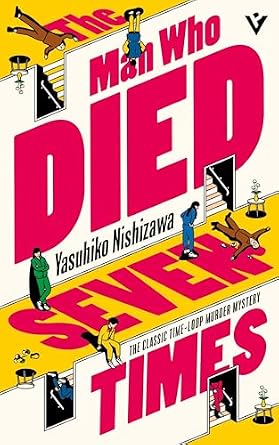
Yasuhiko Nishizawa’s The Man Who Died Seven Times is a Japanese murder mystery with a time-loop twist. The book was first published in 1995 in Japanese and translated into English by Jesse Kirkwood in 2025. This book is perfect for the fans of classical murder mystery fans of Seishi Yokomizo and Yukito Ayatsuji. Unlike the horror element of books written by these writers, Nishizawa has played with the perception of time along with a pretty straight-forward time-loop to make this story stand out.
Hi, readers. Welcome back to another Japanese murder mystery book review. The Man Who Died Seven Times is a pretty popular book that was seeing all over my timeline and decided to take a plunge into this story when it became available at my library. While I did not go in with particularly high expectations for this book, it had a really promising beginning that drew me right into the story.
Title: The Man Who Died Seven Times
Author: Yasuhiko Nishizawa
Read: eBook – Libby
ISBN: : 9781805335436
Published: Pushkin Vertigo, 29 Jul 2025
Page Count: 285
What is ‘The Man Who Died Seven Times’ About?
Simply put, the book is very literally about the man who died seven times and his family. Why the man dies seven times in the book? Well, there is a time-loop in play that his youngest grandchild is privy to, and he spends the entire duration of the book trying to prevent his grandfather’s death.
The premise of the book is morbidly fun. The family has gathered for their routine New Year’s celebration dinner and stay the grandfather’s mansion but there is the succession of the fortune is question. The whole family—3 daughters, 5 grandchildren—in addition to two assistants and one housekeeper and the grandfather are all occupied by the mystery of who will take on the Fuchigami name.
The family history is as dark as it is funny as a turn of fate lands the abandoned father on the verge of suicide a veritable fortune. He and his remaining daughter Kotono end up opening up a restaurant that soon becomes successful with other branches as well and turn into a whole corporation. Kotono remains unmarried and childless.
This brings the two other daughters slinking back to their father, specifically, their father’s fortune. It soon becomes clear that the old man is not splitting his fortune equally among his children and Kotono will adopt an heir who will inherit everything. All hell breaks loose.
The story is told from the perspective of Hisataro, youngest son of the eldest daughter, Kamiji. Hisataro has this unique phenomenon happen to him where certain days get stuck in a loop of 8, repeating themselves relentlessly. He has no control over which days get stuck in the loop or how to trigger this Trap.
On his visit to the grandfather’s house on New Year’s Eve, he is planning on being thoroughly entertained by the curious characters of his family as they start vying for the position of the heir and be adopted by his Aunt Kotono. Instead, he gets stuck in the Trap and his grandfather is found murdered. Hisataro feels personally responsible to save his grandfather because of the loop despite not having particularly fond feelings for him.
He soon realises that one of the people present in the mansion has to be the culprit. This Trap takes on the shape of a detective story as Hisataro tries to prevent the murder by trying different scenarios—learning and exposing secrets as he goes—only to fail almost every time.
As time keeps running out for him to prevent this murder more than solving it, he keeps getting desperate to get out of the Trap. More than his grandfather’s life is at stake in this tale—his and his family’s survival depend on the choosing of the heir and grandfather’s death is a major complication to all the plans laid by each of the family members.
My Verdict: Is ‘The Man Who Died Seven Times’ by Yasuhiko Nishizawa Worth It?
This book is a masterclass in character sketches. There are 11 present members of the family who have been sketched in complex details—nobody is above reproach. Even grandfather is not an innocent victim of his family’s greed, he has put machinations into motion that bring about his death. All the family members are hiding secrets from one another, and the reveals are almost always comical.
I like unreliable narrators and morally grey protagonists, in that regard, this book delivered. Hisataro is a high-school kid with an enormous responsibility—prevent a murder, not just solve it. He is not the brightest bulb in the lot as well.
The writing was funny in its social commentary as well—what else would you expect for a narrative perspective of a high-schooler. But Hisataro’s misogyny is also apparent in his critique of his family—he thinks his mother hysterical, aunt conceited and cousins dramatic. In his defence, they are all of these things.
Having read all of Yukito Ayatsuji’s and a large portion of Seishi Yokomizo’s translated murder mysteries, I am not surprised by the misogyny. Considering this book came out in 1995 (a shin-honkaku), while Ayatsuji and Yokomizo’s works are post-World War II; I am forming an interesting historical picture of Japanese society through these honkaku books.
The mystery was fair play but the discrepancy in the time loop was explained away without much logic to it. As a result, I am not on board with the ending of the book. As I read more, I am coming to this conclusion too often that I do not like how the plot is all wrapped up with a bow without much nuance and everything is explained away with rudimentary logic. But if the readers can suspend their disbelief about a teenage boy getting stuck in time loops randomly, maybe they can stomach the ending as well.
I rated this book 4 stars and would definitely recommend to readers of Japanese mysteries.
Pick up a copy of the book here: buy book.
Request book reviews and get updates on latest reads here: connect with me.


Leave a Reply