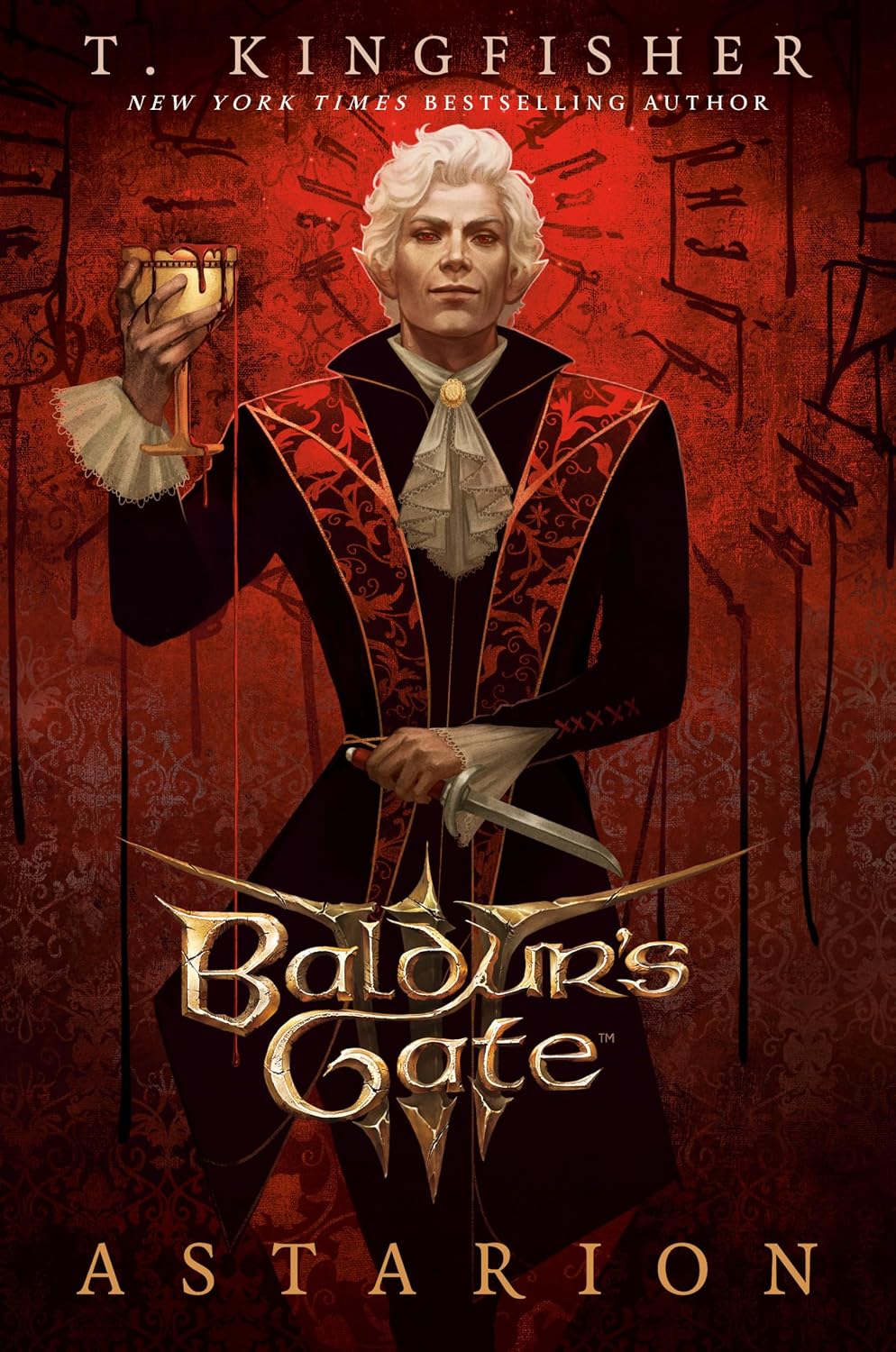
Have you ever read a complete 5-star book and never wanted to talk about it again? That is me with Baldur’s Gate 3: Astarion by T. Kingfisher.
You already know I am a huge T. Kingfisher fan; I will read her grocery list if she lets me. So, it was surprising to me when I heard about all the backlash against the Astarion book. I had to pick it up immediately and see for myself what all the fuss was about.
So, with that, let’s dive in!
Plot of the New T. Kingfisher Book: What is “Baldur’s Gate 3: Astarion” About?
The book is an official tie-in with the game Baldur’s Gate 3 for the infamous vampire character Astarion. As someone who has never played the game or even heard of it before the announcement of the book, I felt the world-building was succint for a character-led plot.
For a prequel for the character of Astarion, it was already expected to be tragic. The narrative set up dual timelines, one gave the readers a glimpse of Astarion’s earlier life before he came to Baldur’s Gate, the other added to the lore of Astarion’s existence as Cazador’s vampire spawn.
If you ask me while parallel timeline was sadder, I couldn’t tell you.
Astarion’s earlier life encompassed the wonder of childhood and the rose-tinted glasses of youth. The hopes, dreams and burdens that are imposed on Astarion before he even understands what he is agreeing to are difficult to read about. Neglectful parents, half-told family secrets and the search for identity chase him doggedly throughout his time before he moves to Baldur’s Gate.
Astarion is raised on a vineyard by his parents where he doesn’t quite fit in. When he finds out about his true elvish heritage and a distant relative willing to take him in, young Astarion chooses to stay. But he does not understand the legacy he is about to inherit. While he spends his days in perceived finery and leisurely learning the ways of the world, his character is framed and fate is sealed.
Astarion finding his love for law, working in Silverymoon for a distant cousin, is like watching this character come into his power.
While this older timeline is all about the wonder of what Astarion hopes is finding his footing in the world, silly crushes and fine silks, the present timeline is all about his agony living with Cazador and his vampire spawn siblings in Baldur’s Gate.
The vampire lord, Cazador, turns and tortures his spawns at him whim for his amusement. This Astarion has been living under his control for over a century. He has learned to not care about things he used to care about. He has learned to hide his feelings acutely.
This is when a task is set before the spawns. They are to bring Cazador the blood of a being that would surprise him, in return, one of them would win the chance to be turned into a full vampire.
While Astarion recognises the situation for what it is, a trap, he has no other choice but to participate. He forms allies and figures out plans to find the blood of a dead god. Yes, there is a paladin. Yes, the situation is laughably tragic from all angles.
My Verdict: Should you read “Baldur’s Gate 3: Astarion” by T. Kingfisher?
If you like reading T. Kingfisher books, regardless your familiarity with the Baldur’s Gate 3 video game, this would be a very enjoyable book to read for you.
But be prepared for all the subtle and not so subtle hints towards all the toxicity. Astarion’s trauma stems from his parental figures, the tragedy is in the fact that it refers to all his parental figures.
While his parents were mostly neglectful, his great-grandmother providing in her own way, Cazador is mortally dangerous to him despite him now being almost immortal. Cazador takes his life and sucks out all the joy and sense of self from him. What little identity Astarion clings to pivots around his love for luxurious fabrics and his small rebellions against his lord father.


The descriptions of what Cazador did to Astarion, though mostly off page, are brutal. The mindless torture inflicted on Astarion just for the sake of it, the isolation of an almost-immortal existence and living under the thumb of a sadist vampire lord is taxing to read.
It took me over 2 weeks to read this 288-page book.
I have seen numerous conversations on the internet where it has been difficult to read for a lot of people. The depiction of violence, of toxicity from a parental figure is too real. Especially, if the reader is someone who has experience with controlling, narcissistic parents or partners, beware.
This queer vampire spawn is on an adventure otherwise. He is spoiled, brutalised and practical. He is also insufferably obsessed with himself as a coping mechanism. The character of the paladin, den Suriel, works as a foil to everything Astarion is.
The description of the gritty underbelly of Baldur’s Gate is intriguing on its own merit. There are creatures, gnomes and dragons the least of them, that populate this expansive city with all its quirks. T. Kingfisher does a great of bringing it all to life for gamers and non-gamers alike.
I rue the day I have to rate a T. Kingfisher book low, but this was a solid 5-star read.
Have you read any of Baldur’s Gate 3: Astarion book by T. Kingfisher or played the game? Pick up a copy of Baldur’s Gate 3: Astarion: buy book.
Request book reviews and get updates on latest reads here: connect with me.


Leave a Reply