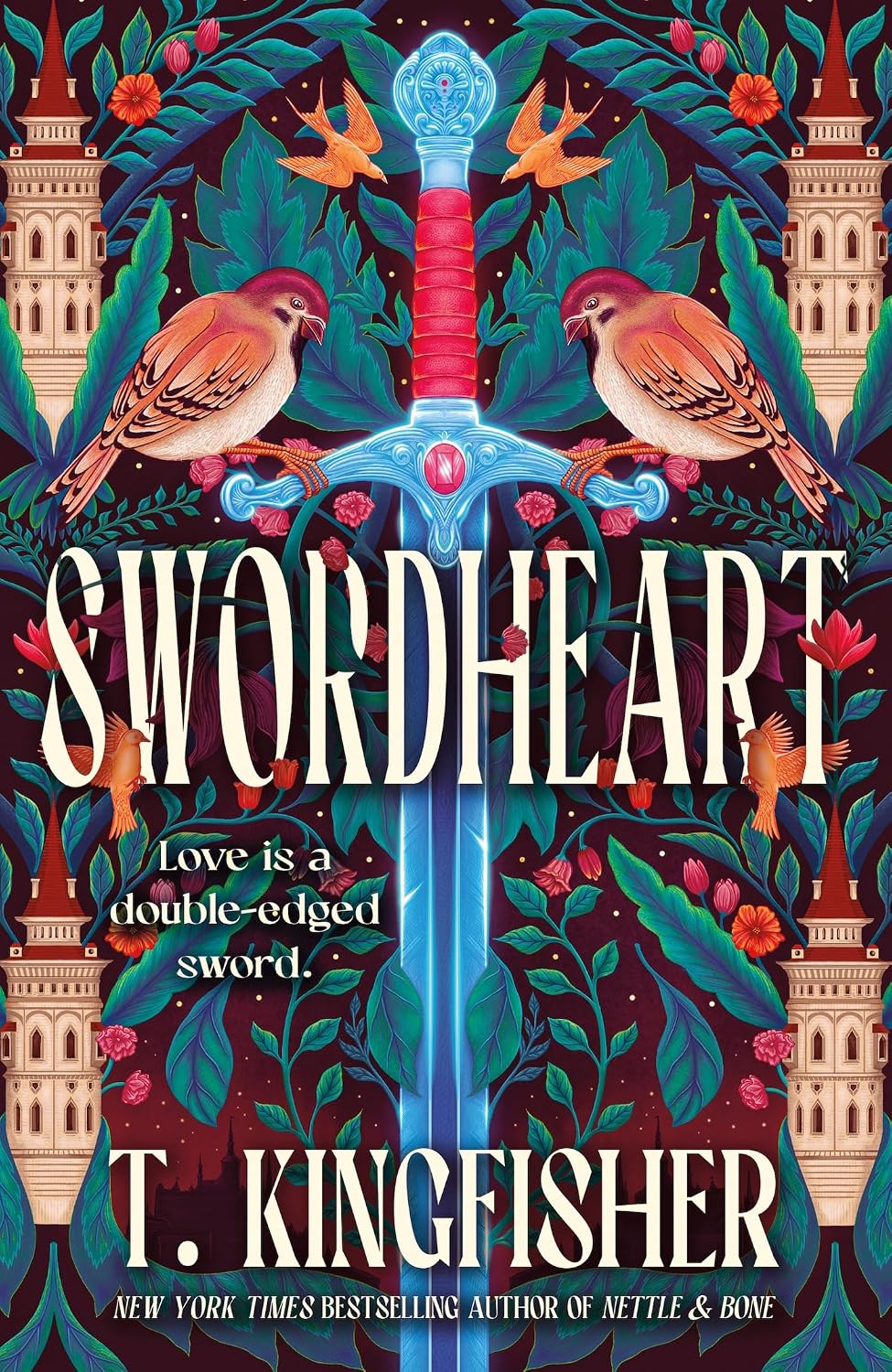
If you think you are picking up Swortheart by T. Kingfisher to read a fun little book about a man stuck in a sword (not like a genie) sworn to protect the wielder, you would be partially right. But underneath all the funny bits of how a regular rural widow gets stuck with an immortal warrior bodyguard (yes, they are both stuck in their situations), you have harsh social commentary on gender roles, slavery and toxic familiar ties.
If that sounds like something you would enjoy reading, you can add to it the dry humour of T. Kingfisher, incredible character arcs and queer characters, and go for this story for a Fall read.
If I am giving fan energy, it is because I am. T. Kingfisher is my most read author this year and I have had only winning reads from her. In fact, Swordheart has been my least favourite book by her, and it is still a great one. So, with that, let’s get into the book review!
The Plot of ‘Swordheart’: What is the book about?
The overarching plot of Swordheart by T. Kingfisher is that a widow, Halla, discovers a sword in her room while contemplating suicide to avoid marrying her cousin. She has been left the sole heir to her rich relative on her deceased husband’s side and the dead relative’s own family are not very happy about it. Cousin Alver, goaded by his mother, is forcing Halla to marry him to keep his father’s fortunes in the family.
And Halla would rather die than marry a man with clammy hands.
So, while her family has got her locked up in her room until she agrees to marry the cousin, she draws this sword to end her life. But lo and behold, an ancient warrior appears hell-bent on saving her from any and all dangers.
Commander Sarkis has been imprisoned in an enchanted sword by a mad smith for about 450 years. By the time Halla draws his sword, the smith has been anointed a Saint. The enchanted sword(s) are part of the cult’s lore and they would do anything to get their hands on them.
Sarkis has no idea about any of this. He has a problem-magnet on his hands for a wielder, and he has to protect her. While Halla is an improvement on the wielder who used to cut Sarkis’ tongue out, he is constantly exasperated by Halla’s string of questions about anything and everything. Regardless of this, he needs to help Halla secure her inheritance to save her from her murderous relatives.
This mission requires Sarkis to rescue Halla from captivity and take her to Archon’s Glory to meet with the lawyers of the Rat. At this point, the plot seamlessly joins The Saint of Steel series in The World of the White Rat universe. But this is only the first part of the mission.
As Halla and Sarkis journey from Rutger’s Hollow to Archon’s Glory and back and then journey some more, they are falling for each other. Sarkis is guarding the reason for his imprisonment closely and Halla is struggling with the society’s expectations of a respectable widow.
The story encompasses their journey to reclaim their identity and inheritance. The quest style writing and all the journeying is reminiscent of the classical high fantasy books. The book has mixed pacing but is never boring.
Do you need to read The Saint of Steel series or The World of the White Rat Series before you read Swordheart?
The World of the White Rat series has 6 books on it before Swordheart and is followed by Daggerbound (out now) and Shieldborn (to be released in 2027).
The primary works of the four Paladin books starting with Paladin’s Grace make up the Saint of Steel series. Then, there are the Clocktaur War duology containing Clockwork Boys and The Wonder Engine.
Even though the series and universe might sound like a lot, the books are very well-written to give the readers all the context required to the point that you could read the books in the entire World of the Rat series in any order.
I started with the Saint of Steel series, Paladin’s Grace. I made my way through those 4 paladin books to then read the Clocktaur War duology and then read Swordheart and Daggerbound. Out of all released 8 books, only the Clocktaur War duology needs to be read in order because it is one big story split into two books.
The ideal chronology would be to start with the Clocktaur War duology, following it up with The Saint of Steel series and then start on the Swordheart series. But you can definitely just read Swordheart as a standalone as well. In fact, I just finished reading Daggerbound, the second book in this series, and it could have been read as a standalone as well.
There are character references and old characters making appearances, but the contexts within the books themselves are enough to parse the significance on their own. This flexibility is one of the primary reasons I have come to love T. Kingfisher books.
My Verdict: Is ‘Swordheart’ worth reading?
Swordheart by T. Kingfisher was published in 2018, it is one of her earlier works. If you are familiar with her more recent works, you might find Swordheart to be a little juvenile (all those sword jokes) and a lot meandering (traversing the same road thrice).
While Kingfisher’s more recent works have found that maturity in representing characters that are not the usual run-of-the-mill teenage avengers, Swordheart is towards to starting point of this concept she perfects.
For reference, Clockwork Boys and The Wonder Engine were written in 2017 and 2018, respectively.
Do I still think Swordheart is an interesting read? Yes.
Would I read Swordheart again? No.
The silly factor of a loud but insecure widow and an exasperated old warrior reduced to a bodyguard is balanced by the undercurrent of the commentary on slavery. Halla technically owns Sarkis because she owns the sword. She can give it away or die, and the next wielder will be Sarkis’ next owner.
While Halla is horrified by the prospect of giving away a person, having such power over him, she is also someone owned by her male relatives in the absence of her husband. The whole point of contention about the will is that Halla, as a woman, cannot be the heir to a fortune without having male guidance. She is accused of seducing the old uncle by the aunt, doing witchcraft on him and when she flees the house with Sarkis, an embarrassment upon the family for debasing herself with a guardsman.
None of the heavier commentary is laid on thick, none of the more serious issues discussed in the book is didactic. This is classic T. Kingfisher style of writing where she keeps the tone of the narrative light and her characters almost flippant to still depict the hardships they are subjected to for no reason whatsoever. I am definitely a fan of this writing style; it makes the stories more real and the struggles more apparent.
The magic system is mostly contained within the paladins and this sword. But the creation of the sword is almost an alchemical process, making this book, and honestly, the whole universe, somewhere between sci-fi and fantasy. The book is light fantasy with no overarching magical world-building. The stakes are low enough in Swordheart to be called a cozy fantasy perfect for Fall TBR and it is entertaining enough to keep you completely engaged.
So, if you are thinking about giving Swordheart a try, this might be a good time to get to it with Daggerbound‘s recent release and the expected release of Shieldborn in 2027.
Have you read any of The Saint of Steel or The World of the White Rat books by T. Kingfisher yet? Pick up a copy of Swordheart here: buy book.
Request book reviews and get updates on latest reads here: connect with me.


Leave a comment