
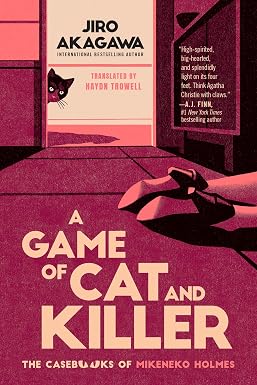
I am back to reading Japanese murder mysteries again! This is the perfect cozy weather for thrillers and mysteries. While A Game of Cat and Killer by Jiro Akagawa, translated by Haydn Trowell is pretty gory with all its bloody murders, it does have a cat solving the mysteries, so I would count it as a cozy book.
I have very little I liked about this book beyond the cat. The mysteries are really not what you call fair play. But would I read the next translation of this series? Yes. Let’s get into it!
Plot of A Game of Cat and Killer: What is the Translated Japanese Murder Mystery about?
The book opens with a murder of a student at a women’s university getting murdered for turning tricks on the side. Then the book proceeds to a locked-room murder. The serial killing of students in the university continue in the background.
The protagonist of A Game of Cat and Killer is the police detective, Katayama, in charge of the locked-room murder. He has to figure out who killed the man in the locked room while the rest of the precinct works out the student/prostitute murders. The USP of having a cat solve the murders also expose the blatant incompetency of the rest of the detectives.
While Katayama takes the case at a women’s university as a signal to finally find himself a wife to take care of him, he is barely involved with the case anyway. His young sister is acting mysterious, his meddling aunt is pestering him with arranged marriage dates and he is constantly tired from doing just the legwork supporting his senior, Hayashi.
The letdown of the story is not even the poor detective; it is the overall shallow characterisation and the complete lack of any real mystery. I would give the book its laurels for a pretty clever locked-room murder, I definitely did not see that coming.
Everything that Works and Does not Work in A Game of Cat and Killer
Not to give out my opinion on the book too soon into this review without laying out the pros and cons, but this book had almost equal number of things going for it as it had complete letdowns. Beware the spoilers.
Weak Characterisation Dilutes the Thin Plot Down Further
Katayama personally offended me with his shallow observation skills. He was so busy at first, being nervous and shy around pretty women and then, trying to sleep with one of them, that he doesn’t stop to think he is compromising the case. The woman he gets seduced by is the victim’s girlfriend and when he is getting asked to sleep with her within a week of the murder, he does not stop to question the merit of the situation.
She is pretty, he is into it. Why does the case matter anyway?
The narrative being from Katayama’s perspective, the readers get a front-row seat for his misogynistic worldview. He is constantly commenting on women’s appearances. He proclaims he can talk to ugly women normally, but it is the pretty ones who get his tongue tied. But his judgement is not limited to the women he sees around himself. He is only impressed by the sharply dressed, neat Dean Morisaki. So, he doesn’t really suspect any of the other professors or the President.
Hayashi is the good guy, Mitamura and Harumi are the ambiguous one, President Abe is the ridiculous one, and Yukiko is the campus beauty. These characters are reduced to their defining traits. But the plot itself is not very impressive. I had the who of the locked-room murder solved from when the body dropped and I do not even read that many murder-mysteries. However, the how of the locked-room was laid out pretty cleverly. As for the serial killer, the payoff was not fair play at all. It was portrayed as random, those students, that method of killing and the apparent lack of motive behind it all.
One-Dimensional Women who are Actually more Complex
The flip side of the one-dimensional characters is the two women on the pedestal, Harumi and Yukiko. They are the only exception to all the other female students in the cast of characters. The other students at the university are pretty chill about having the side gig of prostitution to meet the cost in the city.
Harumi, Katayama’s sister, is the epitome of grace. She is taking care of her absent-minded police officer brother since they are orphans. She cooks for him whenever he comes home, late night or early morning, and cleans up after him. He thinks he needs to get married because Harumi is reaching the marriageable age and after she is gone, he would need someone to take care of him. That is all the thought he spares his sister, until the meddling aunt brings up the fact that Harumi has been spotted late at night with an older man.
Communication between the siblings is one way. This is most apparent when Harumi feels no awkwardness is talking to her brother about his dating life and his work, but Katayama cannot bring himself to ask her about her evening or what is going on in her life. Well, there is a lot going on in her life. Curiously, she does not have access to funds to get emergency medical procedures done and has to steal from Katayama. Finally, she leaves a note for her brother explaining everything and exposing the limitations of this brother-sister duo.
Then there is Yukiko, the campus genius and beauty who has the men of the campus wrapped around her fingers. But she is put on a pedestal and painted as the epitome of virtue. Katayama, a staunch judgemental fellow otherwise, asks her to marry him after knowing her for a week. The gotcha on Katayama pulled by the plot was a funny aspect of the plot that was really good to read about. Yukiko’s character, though complex, was not really unpredictable.
While I like that both Harumi and Yukiko have some substance to their character, both still feel shallow. Harumi’s storyline felt superfluous to the main storyline and Yukiko was predictable even though Katayama could not see it.
Unnecessary Un-Fair Play on the Mysteries
I really liked how the locked-room mystery was solved despite the protagonist detective serving as an interpreter for the cat, Holmes. There was real potential for the author to flip the script and introduce a different killer for both cases. Maybe even some event tying the two separate cases together.
The locked-room mystery’s involvement with the family, work and romance angles, I found it exciting to read. But the serial killer case felt like a filler storyline, as a lure to get the detective to the university. The problem is it could have done without killing of a bunch of young women brutally.
The author might have been trying to add a social commentary about morally policing women in the context of 1978. But making these murders completely senseless did not add to that commentary. The mental health issues are brushed aside too quickly and so is the sermoning against the female victims for debasing themselves. The plot set up the premise but failed to execute it to the fullest potential.
The USP of the Cat Solving Multiple Murders but Partnered with the Incompetent Detective
Holmes was an adorable, yet tragic, presence throughout the book. The smartest character in the book was only listened to by Katayama, there is some use in that detective afterall.
Holmes had made the university her home with her master. Comfortable around the students and faculty, this feline has a great sense of character and she is lithe enough on her feet to direct Katayama to the pertinent clues. From the hidden threatening letter to the logic behind the locked-room mystery, Holmes even goes so far as to solve the serial killer case for the precinct as well. The latter would not have seen a resolution without her intervention, there is no clues present at any of the scenes. We do not know what made Hayashi suspect the killer and if the killer was in their own mind when they attacked the senior detective.
The plot holes in the story are left as is. The author does not even attempt to tie them up neatly. The book raises a lot of questions and is unable to provide most of the answers. The curious cat’s calm demeanour while she points out the discrepancies in the cases and solves them only ends up highlighting how little effort and brain the detectives are using. I am not mad that the cat is smarter, I am a little mad that there is not even a hint of effort from anyone and a half-hearted one from Hayashi.
My Verdict: Should you read A Game of Cat and Killer?
If you are not the biggest fan of cats and can just be impressed by the cat’s skills, I suggest you skip this Japanese murder mystery for better options. I recommend Yukito Ayatsuji’s the House Murders series or even Seishi Yokomizo’s Detective Kindaichi series. Uketsu has un-fair play murder mysteries featuring maps and pictures.
Based on the pure merit of the mystery in A Game of Cat and Killer, it is not worth it. As an interesting social commentary, it might be worth it, but even there are better books to even take a taste of that. The cat is cute, but is it enough to make this a worthwhile read? I would have to say no to that. Am I still very tempted to read the next book in the series that gets translated? Yes, I’m invested in what happens to Holmes!
Have you read any other Japanese murder mysteries lately? Which books have caught your attention recently? Pick up a copy of A Game of Cat and Killer by Jiro Akagawa here to support the blog at no extra cost.
Request book reviews and get updates on latest reads here: connect with me.


Leave a Reply