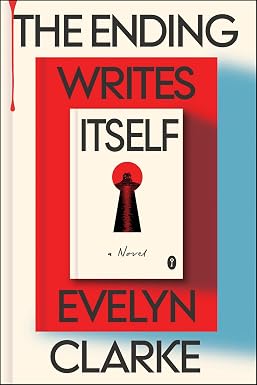
As a fan of V. E. Schwab’s fantasy fiction works, I came into The Ending Writes Itself pretty skeptical. Evelyn Clarke is the pen for author duo V. E. Schwab and Cat Clarke. This is my first time reading a thriller from Schwab and reading any work of Cat Clarke, popular as a screenwriter.
If you go into this book expecting a clever whodunit, you might be disappointed by its predictability. But if you get immerse into the social commentary on the publishing world in this book, you might find a gem. I like books about books and the larger publishing industry. I had really liked the reading experience of Yellowface if not the whole plot. So, very on brand for me, I liked overt and covert criticisms of the publishing industry in The Ending Writes Itself. Let’s get into it!
Plot of The Ending Writes Itself: What is the book about?
Keeping the plot summary very short to give you just the premise and maybe a little on what to expect, I will keep this concise. Do let me know if you would like deep dives into the plot more.
Arthur Fletch is Merriweather Press’ star author. The old man is writing his career’s last book and as one of the most illustrated authors in the thriller genre, the literary world is looking forward to it. So, when he up and drowns on one of his swims at his remote island and castle habitat before writing the ending of the final Petrarch novel, the agent and editor decide to keep it quiet.
They conspire to invite 5 writers from the midlist across genres to a literary salon hosted by Arthur Fletch, author duo of Penn Stonely, Sienna and Malcolm, Millie, Jaxon, Cate and Kenzo. Only, they don’t know Fletch is dead and they are actually asked to compete to finish the ending of the book and win a couple of millions for ghostwriting the book and a separate book deal with Merriweather Press for their next work.
What can go wrong when you lock a few writers on a remote Scottish island with two million dollars and possibly a golden book at stake? A bloodbath ensues.
Themes Explored in Evelyn Clarke’s The Ending Writes Itself
The book is very obviously about the publishing industry from both sides of the paper from the very beginning. The narrative is multi-pov with the authors and the editors chiming in and the characterisation of this wide cast of characters is done really well. If I could have stayed awake, I would have finished reading this book in a day.
Beyond the very obvious exposé, there are subtexts to this book that stood out to me. Beware, spoilers ahead.
The Cost and Price of Ambition
The authors do a great job of giving the characters pertinent backstories. I was invested in their lives, both past and present. The way their lives shaped up what they write and why was extremely well done.
Complex parental relationships drive almost all the stories behind the writers. Jaxon and Millie were done in layers of thoughts that really added depth to these characters. Malcolm and Sienna’s dynamic is completely informed by who they originally were and Kenzo and Cate were the outliers. The jealousy, the snippy remarks and the almost open hostility because someone else has a better deal, more success, more fans were fun to read about.
These aspects also highlighted the cost these authors thought they would have to pay for their ambition to transcend the midlist and the actual price they had to pay.
The Revenge of the Outsider
Kenzo and Cate represent two sides of the same coin. While Kenzo is not really accepted into the inner circle because he has a day job, Cate is not even a writer. Both kept their secrets almost to the end. Cate’s revenge is brutal and bloody and somewhat non-specific; I almost thought she would have a connection with Arthur Fletch to target this retreat and his agent specifically. Kenzo’s is more nonchalant.
Both characters are sort of outside looking into the greenhouse of the other writers fighting it out amongst themselves. I was surprised by how little they actually wrote over the literary weekend. Kenzo’s epilogue chapter gives the reader a view of the rewards he reaps by playing the game and subtly holding the responsible people accountable.
Cate’s ending, while just, saddened me because it represented how difficult it actually is to break into the industry. Beyond the horrors of everything Cate does over the weekend, the threat of AI in fooling industry veterans was seamlessly added to this tapestry of deceit and murder through her storyline.
The Glass Ceiling Unbroken
I am looking at the women of the story here, Cate, Sienna, Priscilla and Millie. Try as they might, they fail to establish their names in the industry or even get the much deserved acknowledgements.
For Cate, she saw her mother waste her life away for one chance at writing her stories and wanted to avenge that lost life by cheating. While the hard work does not guarantee the results, you definitely do not make it without the work. But I would count Malcolm in the same category. Stealing your wife’s words or plot is just the precursor of using AI to “write” a book.
For Sienna, living in Malcolm’s shadow and not being acknowledged for her work created a deep resentment in her that ended up in big decisions. While excruciatingly disrespectful, she initially chooses this life because of the safety net Malcolm provides. She skips several steps in the ladder but cannot push them both up the midlist alone. As she increasingly gets taken for granted, she reconsiders her life choices. But by the time she chooses to leave, she is already trapped in another snare.
For Priscilla, she can take up the project and make this whole ordeal go away at any time. She can call off the competition any time, but she wants to see a winner at the end of the ordeal. She doesn’t trust herself enough to write the ending herself. When she finally thinks how hard it can be, she is left staring at a blank page and blinking cursor. Her quitting the industry and moving away without any acknowledgements from the key players is the ultimate loss. I would quit too if nepotism was staring at me the way it was staring at her with eager eyes.
Millie who initially wrote literary fiction is told by this industry trying to manufacture talent that her age and appearance would suit YA better, fantasy and romance. She changes track. She commits to the bit. After all her efforts, she gets ridiculed for the persona she created because of the market demands. You can’t win this game.
The Burden of Overactive Imaginations
Despite the NDAs and deceit, the book deals were fair for the writers invited to the literary salon. The straight-forward deal of leave your electronic devices in a safe for 72 hours and write Arthur Fletch’s epic ending to the most popular series, and may the best writer win, is a path to success that none of these writers have been able to carve out by themselves.
When presented with this opportunity, they try to solve Arthur Fletch’s murder, kill off one another and try to steal other people’s works. Their overactive imaginations are their Achilles heel. While they fail to channel their own energy to their works, they invent ghosts and shadows. Sienna and Millie minded their own businesses as much as they could. Jaxon got locked into the room to finally be able to write. Kenzo was fuelled by the deadline and Malcolm by his dead wife’s notes.
When the bloodshed begins, I was left with the thought “What a waste.”
My Verdict: Should you read The Ending Writes Itself?
If you are going to be a spoilsport and lament “But the murder, the whodunit, the mystery”, The Ending Writes Itself by Evelyn Clarke is not for you. A seasoned thriller reader can take a look at the contents page and tell you who the criminal is.
This book is more about the nuances, the varied characters of writers and editors and the ruthlessness of the industry. While it is not quite satirical, the plot hits you in the head with the points it is trying to make, it is a scathing critique of how meticulously every organic engagement and appearance is being curated behind the scenes.
While it lacks the subtly of Yellowface by R. F. Kuang, The Ending Writes Itself by Evelyn Clarke is a thriller in its portrayal of the brutality of the publishing industry and deserves its accolades.
Have you read any other book about books or the publishing industry itself? Which books have caught your attention recently? Pick up a copy of The Ending Writes Itself by Evelyn Clarke here to support the blog at no extra cost.
Request book reviews and get updates on latest reads here: connect with me.


Leave a Reply