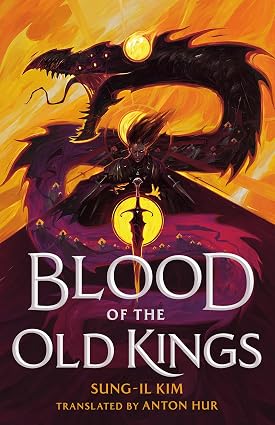
If you are looking for a non-Western Fantasy Fiction in translation without being dumped into a completely alien world, Sung-Il Kim’s Blood of the Old Kings translated from Korean by Anton Hur is your answer. This is the first book of The Bleeding Empire trilogy and the final book in the series was just released. If you like to binge books in a series, this is the perfect time to jump into this.
I have been eyeing Blood of the Old Kings since it was published in English in 2016. I wanted to wait for the series to complete before I started reading it, so here we are. The book was both impressive and underwhelming. I’ll explain.
What is the Plot of Blood of the Old Kings by Sung-Il Kim?
I am cutting down on the detailed plot summary these days, so I will give you the short overview here. Do let me know if you would prefer more detailed breakdowns.
The book opens with an exciting scene of Loran waking the dragon in the volcano to avenge her dead husband and daughter. The dragon is sworn to protect the royal line of Arland, but the Arlanders were defeated in a battle against the Empire some 20 years ago. So, the dragon now slumbers in the volcano tied down in runic chains.
Loran was a swordmaster in her town when her family was taken away and unjustly killed off by the tyrannical prefect of Kingsworth, erstwhile Arland. She needs the dragon’s powers for revenge. But she is not related to royalty at all. The dragon would only help the King.
So, this older FMC promises to become the King of Arland. Her personal tragedy takes on the burden of a much larger goal, defeat of the Empire and liberation of Arland. But this is no small task.
Cain lives in the Capital. He has recently lost his friend Fienna and needs to find out who had the good-natured woman murdered. While he gets dragged into a sort of gunpowder plot, this Arlander has to decide his loyalty while avenging his only friend.
Arienne has escaped from the Academy with a Power Generator hidden in her mind. As a sorcerer from Arland, she is fated to become a Power Generator in death and dedicate her life to powering the Empire–lights to war machines. But she cannot fathom wasting away and being used by the Empire this way even though she doesn’t feel any particular loyalty to Arland. So, when the mysterious voice in her mind promises to teach her magic and help her escape, she agrees to steal for him.
As these three stranger travel across the Empire to their own ends, they weave a tapestry of bigger changes occurring in the Imperial land.
Themes of Sung-Il Kim’s Blood of the Old Kings
This epic fantasy has set the stage for quite a few serious themes in the first book. With a narrative that is reminiscent of the old-world stories and an ambiguous setting and characters’ intent, it is really interesting to see where the author decides to take these socio-political issues.
The Politics of Magic vs Science
Set in vaguely medieval times in an unspecified region of the world, the book’s premise is based on the central theme of magic vs science.
The Empire has captured three separate kingdoms: Arland, Kamori and Ledon, and has abolished the use of magic. Now, they use the magic-wielders to power their cities, machines and weapons. The necromantic magic behind the scenes that power the Empire’s machines is using the bodies of the sorcerers themselves. It’s a pseudo-science rooted in control of power.
The Empire tests children of the occupied lands and take them to the Academy where they are taught just enough to be either professors to teach the next batch of students or sorcerer-engineers to maintain the Power Generators. At the end of their lifetime, all of them are headed towards on destiny, serving the Empire as a Power Generator. This sort of slavery that doesn’t even end in death is a fate that is not even questioned in the Empire anymore.
Imperial Rule Harking Back to Korea’s History
The parallels of Korea’s long history of occupation at the hands of Imperial Japan is pretty evident in this book.
The erasure of inheritance of culture and magic are added to the political overview of the Empire. As a means of control, they not only take away the magical children of the occupied land but also compel them to serve the enemy in life as well as death.
The readers are only introduced to Prefects and Imperial Legionaries in this book. Even though part of the narrative plays out in the Capital, we get no glimpse into the Council or the person in charge. If the sense of distance and confusion about the country they live in as Arlanders was intended, it was successfully achieved.
The Threat of Nuclear Destruction
A neighbouring Kingdom of Mercia was decimated by the Empire’s machines. Popularly known as the Star of Mercia is a threat hanging over every storyline in this book.
The images of radiation and complete destruction is evoked with the medieval vocabulary in the narrative. But doubt is also sparked about the use of the machine again or the initial intention to use it on Mercia.
In Cain’s storyline, hints are added that the Star of Mercia was actually a mishap on the Empire’s end. This is further stressed in Arienne’s storyline when Eldred, the Power Generator Arienne stole, and Lysandros, head inquisitor, face off against each other, and one taunts the other about what happened in Mercia.
My Verdict: Should you read Blood of the Old Kings by Sung-Il Kim?
The epic premises, serious social issues and a three-pronged narrative had promised a proportionate adventure in this series. While it delivers just that, all of it is mostly vague. Beware of spoilers ahead.
The magic and political system is not really delved into. While the Power Generators are explained, the individual magic of Arienne is left vague. The political system is reduced to Prefects who rule cities in the occupied land and Legions that are sent to suppress rebellions. There is the Office of Truth that works as the inquisitor system but there’s a shroud of mystery around them and the Intelligence officers who work there.
The characters are too lofty. Even though all three protagonists of the story come from different walks of life, are of different ages and are in different situations, they almost unquestioningly choose to take the morally right path with minimum coaxing. Loran invested in liberating Arland chooses to aid Kamori, then chooses to surrender herself when Kamori is threatened alongside Arland, then chooses to stay and fight as villagers take up arms against the Empire and follow her, then chooses to sacrifice herself. While Cain, an Arlander who came to the Capital as a child, chooses to foil a gunpowder plot of the rebellion to stave off indiscriminate violence and wishes to protect the provincial people. Most of all, Arienne, younger than the other two protagonists, who was primarily occupied with living a life of her own away from the Academy chooses to aid the King of Arland and break the shackles of the dragon. There is very little personal motivation for Arienne to explain her actions.
Loran, in my opinion, had the most interesting storyline. But it was also Loran who got some untimely time jumps. We only see her fighting once, in the final battle. I was left disappointed with the fact that we do not actually see her take the Imperial fortress near Kingsworth, a pivotal point in the story. We also do not see the end of the final battle.
Despite successfully setting up intriguing premises across three storylines, the world-building was surface level and characterisations were shallow. I wanted to love this book, but the payoff wasn’t there. I still liked the epic premise it set up and the potential this story still has, but the writing did not live up the idea, the execution just was not there.
I would commend the book for the concepts and world it wanted to lay out in the story. The cover art of the book is absolutely gorgeous. But I am left underwhelmed on all aspects. I would continue with the series to see how this is wrapped up, so keep an eye on this space for more updates.
Have you read any translated Fantasy Fiction yet? Which books have caught your attention recently? Pick up a copy of Blood of the Old Kings by Sung-Il Kim here to support the blog at no extra cost.
Request book reviews and get updates on latest reads here: connect with me.


Leave a Reply