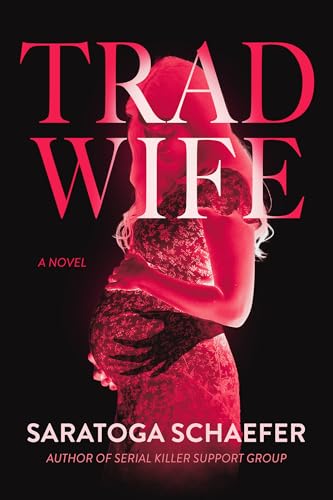
I have been devouring books in the niche genre of Trad Wife Horror. Of course, Saratoga Schaefer’s Trad Wife was on my TBR this November. As Trad Wife Horror lives up to its peak and the body horror of the genre firmly establishes itself, Schaefer’s work is perfectly positioned for readers looking for both.
The other books I have read in the genre, Yesteryear and Sarah Langan’s Trad Wife, show a distinct confusion that I have found to be unique to this emerging sub-genre Trad Wife Horror. Saratoga Scaefer’s rendition is anything but confused. While it suffered its own pitfalls regardless, it knew where it wanted to go from the beginning and it kept the plot on that track.
So, let’s get into it!
The Plot of Trad Wife by Saratoga Schaefer: What is this Trad Wife Influencer Horror actually about?
Camille has been brought up to be a wife. From taking care of her father from a young age following her mother’s death to now being the homemaker to Graham for the past 3 years, she has fulfilled the duties and societal expectations.
She only wants for a baby now.
Yes, a baby would complete Camille’s family and kick start her final role as a mother. She expects the baby to bring back her husband to her too. But more than all of those aspects, a baby would help with her plateauing social media following.
She has recently convinced Graham to move to the countryside, an hour from his work, to fit into the aesthetic of trad wives’ community that she follows online. Beige aesthetics with minimalism are her primary concerns. It is still not a real farmhouse or ranch yet, like the influencer she idolises, Mara Shoemaker, has.
Desperate for a baby in the middle of a fraying marriage, Camille makes a wish in the well beside the forest near her house for the baby. When something crawls out of the well to follow her home and haunt her sleep, she is convinced that God has sent an Angel. While a rational part of her brain points out the horns, scaly grey-green skin and leathery wings to be something more unholy, she is quick to shut it down.
Camille has the Angel’s baby and there’s no immaculate conception about this one.
The pregnancy was quick, too quick, and the baby is growing just as fast. Camille’s daughter, Sweetheart, has the same grey-green complexion, white eyes and claw-tipped nails. But the most concerning are the sharp, pointy teeth that a month-old baby should definitely not have.
The appetite of the demon baby(?) keeps Camille bleeding and then, making others bleed. The lack of community and the unsupportive partner almost take the backseat of this narrative until social media is out of Camille’s priorities and the fierce urge to protect Sweetheart kicks in. Then, she would do things she had never considered doing. Then, she would say things she knows she shouldn’t be saying.
The fact that Sweetheart’s real name was very cleverly glossed over is a quiet little detail of this book that I really liked. The author is clearly not in the business of giving away names of Nephilims.
My Verdict: Should you read Saratoga Schaefer’s Trad Wife?
My first impression of the book was that I was reading something clever. After I turned the last page, I thought Camille’s character development didn’t really pan out.
First things first, I really enjoyed the character of Camille and her good-for-nothing husband, Graham. The way both characters are absolutely devote to the archetypical role they are supposed to be playing was absolutely riveting to read.
“Even shaking, choking down vomit, I don’t dare drop the glass. The carpet in our bedroom is white. It would be ruined.”
While Camille religious thought of a baby and how to cater to every need of Graham, Graham thought of only his next meal. That is all the conversation he provided in the relationship unless he was pestering his wife for sex. He is also a very committed liar.
The religion aspect of this book was quite muted. Except for an incredible chapter where a very pregnant Camille steps into the church, starts hallucinating and is violently sick afterwards, there’s almost no presence of religion. I do think that is a missed opportunity to contrast theology with Camille’s science-leaning background.
Camille’s past wasn’t exploited as much as it could have been. I had hoped there would be some intrigue around her mother’s early death, but no. Her relationship with her father is mirrored in her relationship with her husband, that of a caretaker. Her father hinders her higher studies in science the same way her husband stops her from weight training. Both restricting her and binding her within her societal role of a daughter, wife, mother, was cleverly done.
So, when she does step out into the world, I would have found it to be more cathartic to have her be on her own with her daughter and not forming a sort of unholy family unit with the creature from the well.
The book was gory, but hardly scary. The supernatural element is seen as a salvation for Camille’s sacrifices and something that is finally paying off, seeing her as she is. But I was left questioning is Camille’s autonomy isn’t further eroded as she agrees to deals with the devil that she doesn’t completely understand. She did not know what she would get when she made a wish for a child and she did not know what she would get in that child, the sacrifices she would have to make and the demands this unusual motherhood would make of her.
The para-social relationship with the popular influencer in her trad wife niche was very well-written. The isolation of Camille was perfectly completed with the inclusion of the nosy, unstable neighbour, Renee. It would have been more realistic to let Camille have some income of her own or her husband taking her money, but this was not discussed at all beyond the fact that she might get some products sent to her. Her audience size mentioned in the narrative does not support this low estimation.
The beginning of the book felt repetitive in setting up the characters. It was more show than tell. I would have liked to see Graham drawn up worse. The author worked with very limited characters to highlight the isolation of the protagonist, and I do not necessarily think it worked in her favour. Graham’s job, friends, parents and even Camille’s father, were all reduced to phantom voices on the phone while there were so many potentials to have real conversations and interactions.
So even though I wasn’t the biggest fan of Trad Wife by Saratoga Schaefer, I do see the vision. This book was more straight-forward than the others I have read in the niche, and it still retained its nuance. The social critique was heavy-handed, and the supernatural was balanced in religious spiel and cannibalistic thriller. I always love an author who can write a killer acknowledgement, considering how good this book’s acknowledgements were, I am looking forward to reading more by her.
If you are reading in this niche of trad wife influencer horror, you should give Saratoga Schaefer’s Trad Wife a chance. But if you are not, I don’t think you’re missing out on too much. This was a 3.25 star read for me.
Have you read any of Saratoga Schaefer’s books yet? What spooky or straight-up horror books have caught your attention recently? Pick up a copy of Trad Wife by Saratoga Schaefer here to support the blog at no extra cost.
Request book reviews and get updates on latest reads here: connect with me.


Leave a Reply